The following essay gives a brief (archival) history of the 1936 Exhibition using the British School at Athens Archives, the Ashmolean Museum’s collections, and the Myres Archive at the Bodleian Library (Oxford, UK). BSA Archivist Amalia Kakissis graciously guided the search for documents related to the Exhibition in the BSA and Myres Archives.
I. An Archival History of the British School at Athens’ 1936 Jubilee Exhibition
- Charlotte Townsend, British School at Athens and University of Liverpool
- Renée Trepagnier, Ashmolean Museum and University of Bristol
Reconstructing the Archival History of the Exhibition
Introduction
At the 50th anniversary of the British School at Athens (BSA), an exhibition titled ‘British Archaeological Discoveries in Greece and Crete 1886 to 1936’ was displayed at the Royal Academy’s Burlington House in London. This exhibition highlighted the BSA as a preeminent archaeological research institution by displaying objects, drawings, photographs, and architectural plans from the excavations at Knossos, Sparta, Thermi (Lesbos), Melos, Perachora, and Mycenae. The 1936 Exhibition marked an important milestone in the history of the BSA, but it also served to emphasise the significance of archaeology and Greek history to the wider public and raise support for the institution’s development in the difficult inter-war period.
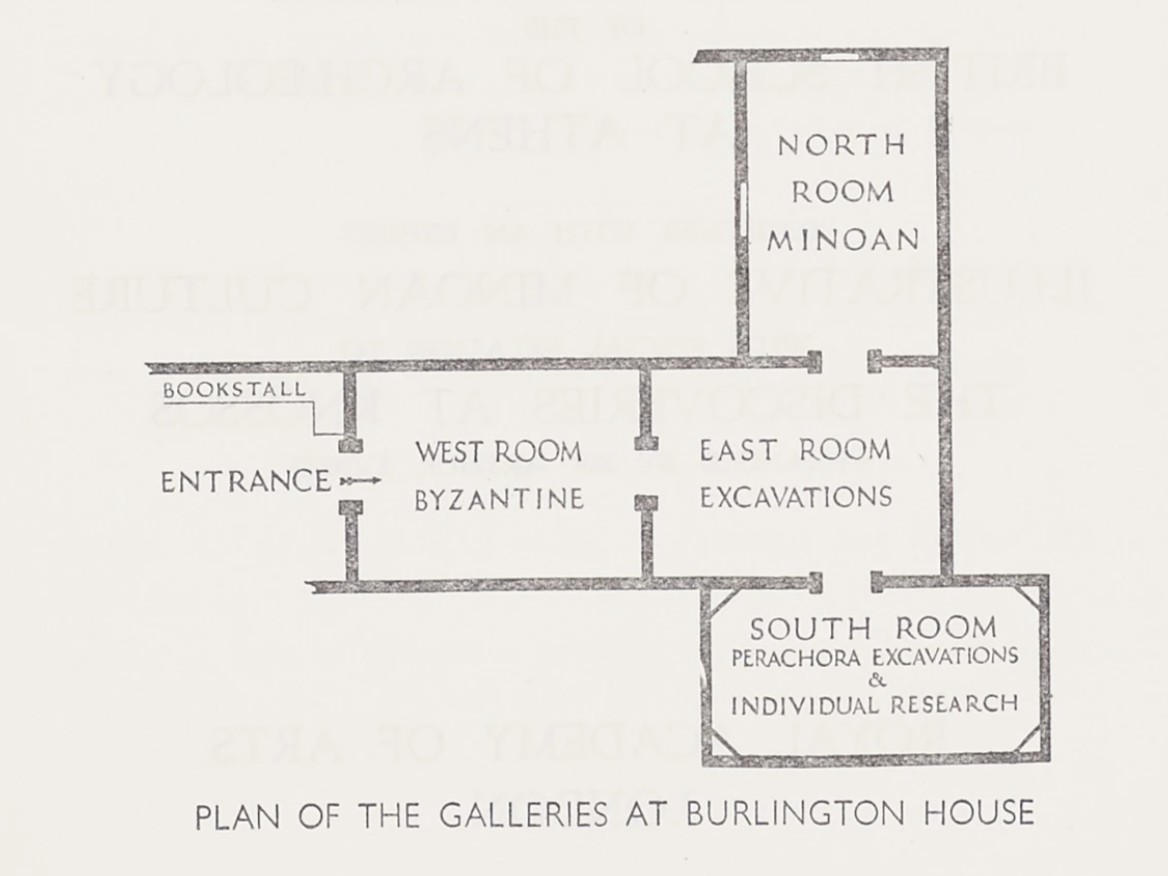
The four rooms of the Exhibition each comprised a different research area of the BSA: Byzantine Materials (West Room), BSA Excavations (East Room), Perachora Excavations (South Room), and the Minoan Civilisation (North Room). Objects were borrowed from the Ashmolean Museum, the Louvre, the British Museum, other academic instiutions and private collectors. Sculpture casts were created by Émile Gilléron fils specifically for the Exhibition and lent by the Government of Greece. Drawings and photographs from BSA Members and Students were displayed on the walls to transport the viewer into the archaeological history of a site. It is obvious from the few preserved photographs in the BSA Archive (i.e., Perachora Temple Models and Gallery Space with Leonidas Cast) and the hundred-page catalogue (recently digitised by the Royal Academy) that great attention was paid to the presentation of the Exhibition and to the knowledge it disseminated to the public.
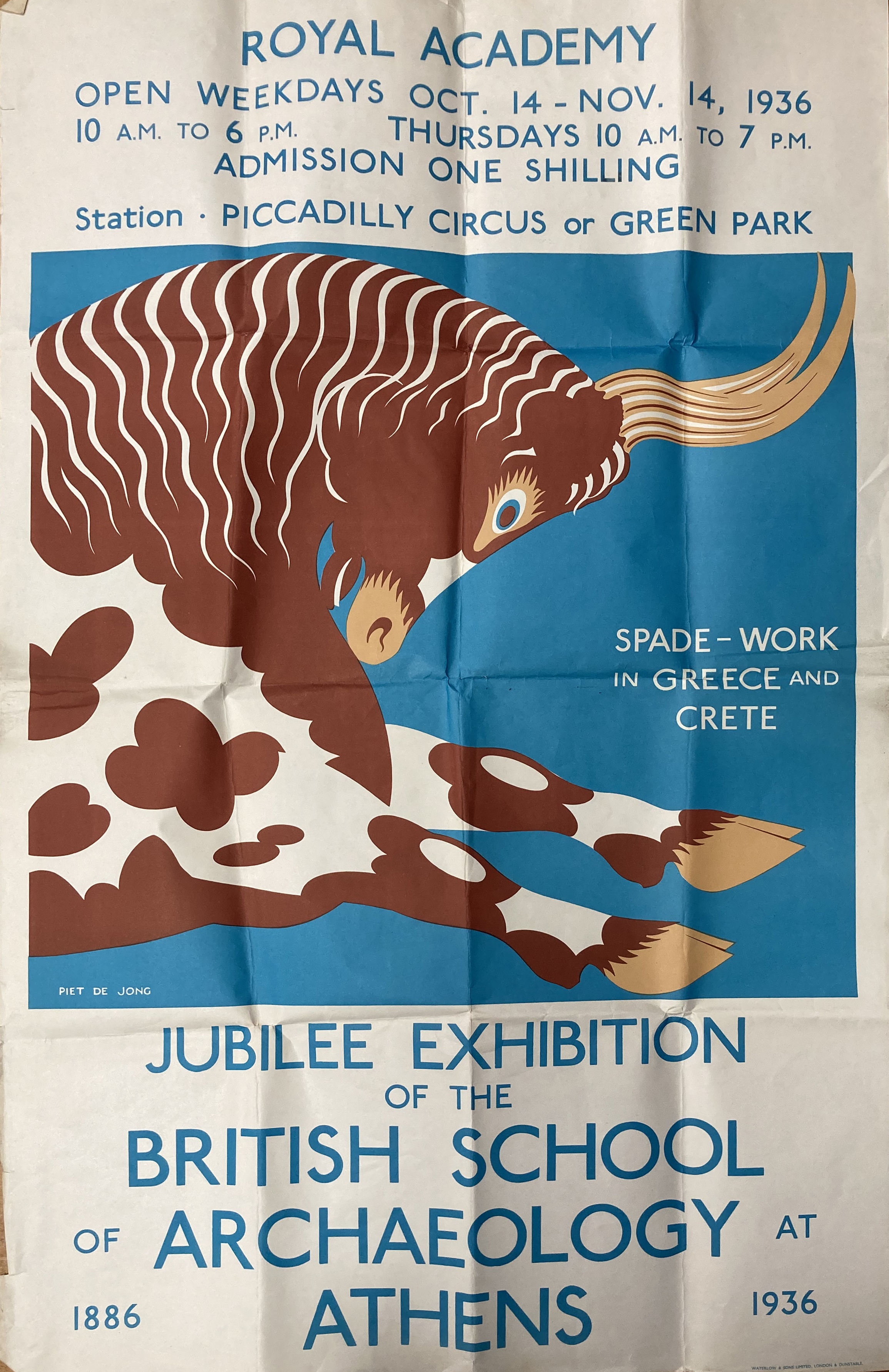
Even by today’s standards of curation and exhibition planning, it was an impressive and successful showcase of the BSA’s archaeological work. In only five weeks, the Exhibition saw more than 11,000 visitors, including the Duke of Kent, who opened the Exhibition, and the Crown Prince of Sweden.4 It boasted a programme of biweekly lectures on the various subjects of the Exhibition (i.e., Knossos, Archaic Greek Art, Byzantine Decorative Art, Orthia Sanctuary at Sparta, etc.) and its bookstore showcased and sold dozens of publications by BSA archaeologists.5 It was marketed extensively, with flyers sent to museums, schools, and societies across the UK, and posters were even created for the London Underground stations.6 After its closing, sections of the Exhibition travelled to Manchester and Edinburgh and several of its casts were sent to the Fitzwilliam Museum in Cambridge, the Ashmolean Museum in Oxford, and University College London.
The creation of this exhibition was a monumental undertaking for the Jubilee Committee, not least for its chairman Sir John L. Myres, an Aegean archaeologist, Wykeham Professor of Ancient History at the University of Oxford, and also the chairman of the BSA. As members of the Jubilee Committee, Sir Arthur Evans, Alan Wace, Winifred Lamb, Bernard Ashmole, Edgar John Forsdyke, John Penoyre, Robert Schultz Weir, David Talbot Rice, Richard Barnett, and Vincent Yorke also helped make decisions about the organisation and design of the Exhibition and its celebratory opening night. Others such as Alan Blakeway, Thomas Dunbabin, Humfry Payne, Mercy Money-Coutts, Edith Eccles, Felicia Stallman, W. Purdon, and Gerald Young helped navigate and iron out the details and issues of the Exhibition. In many ways, the Jubilee Exhibition did much more than showcase the treasures of archaeology. Through its bureaucratic and administrative planning, Myres and the committee brought together scholars, museums, and institutions with varying academic interests, and aimed to strengthen relationships between Greece and Britain. The fact that the objects and archives of the Exhibition are scattered throughout the UK and Greece attests to its collaborative spirit and historic importance. Through the archives of the BSA, the Ashmolean Museum, and the Bodleian Library (Myres Archive), this essay reconstructs the history of the Exhibition.
The Origin and Planning of the Exhibition
The British School of Athens had officially opened on the 13th of October 1886, and so in early 1935 preparation began for a celebration of the upcoming 50th Anniversary. The Jubilee Committee was formed, and by the end of that year they had decided on their initial plans: two separate events, one in Athens and the other in London. The Athens event would be organised by the Director of the BSA, while the London event, projected to be a formal meeting with a small exhibition, would take place on the 3rd or 10th of November 1936.7 This ceremony would be hosted, it was suggested, at the British Academy.8
It was Sir Arthur Evans, in the first months of 1936, who suggested that instead they hosted their exhibition at the Royal Academy. He viewed his excavations at Knossos as ‘School work’ that ought to be part of a commemorative exhibition, but did not think the British Academy had enough space that he would not “overshadow or out-balance” the other excavation work of the BSA.9 The committee agreed with his proposal, and Evans was tasked with approaching the Royal Academy with this venture.
The Royal Academy was able to host the Exhibition in October - the month of the anniversary - and a three week exhibit was proposed.10 This was a significant change from their initial plan of leaving the Exhibition open “for a few days”, but clearly the opportunity to display the School’s work to a larger number of visitors appealed, and the exhibition planning began to move swiftly forward.
The rooms originally hired were rooms IX, X, and XI, which became the North, East, and West Rooms of the Exhibition - the architecture room which became the South Room must have been added to the plan later.11 Different layouts were suggested for the Exhibition: an initial plan was to host Evans’s Minoan material in room XI, prehistoric and Bronze Age material in room X, and Byzantine and later materials in room IX. This changed a few times before reaching the final layout; a later Committee meeting relates the change from Evans to display his materials in room X (See Map of Royal Academy); however, he requested instead to have room IX as it was a cul-de-sac.12 Other members of the committee were also in favour of this, as it meant that visitors would have to walk through the other rooms of the Exhibition in order to reach the Minoan Room.13 Evans also offered to pay the expenses for the table cases he needed himself. Evans’s investment in the project was crucial, as even at this early planning stage the Exhibition was beginning to go over budget.14 The RA quoted £300 for a guarantee against financial loss; the initial anniversary fund was £289.15
Even from the initial stages of the Exhibition John Penoyre was considered to be the best choice for its supervision.16 With the suggestion of the move to a larger premises, he suggested that his nephew, an architect, would be able to help them prepare the Exhibition.17 And so began six months of setup for the BSA’s 50th Anniversary Exhibition.
Setup and Setbacks
The Exhibition setup got off to a good start. Casts were ordered from Gilliéron in Athens18, and the various parties were preparing their sections of the display.
While preparing for the triumph of fifty years of existence, the BSA had something of an annus horribilis. First, in May, came the shocking death of the young director Humfry Payne (1902-1936), who passed away from an infection at just 34 years old. Then, less than a week before the opening of the exhibition his successor, Alan Blakeway (1898-1936), also died. Despite such tragedies, however, the show had to go on.
The Royal Academy closed throughout September until the first of October, giving the School two weeks to set everything up in time for their formal opening. The planning for this rapid set-up began well in advance. Display cases - not provided by the Royal Academy - were sourced from wherever they could be found: Wace suggested asking the V&A, Forsdyke offered to help get some from the British Museum, and Myres offered several table-cases from the Ashmolean.19
With only a short amount of time available to put the Exhibition in place, the arrangement had to be done elsewhere. Evans, with a whole room to fill himself, was provided with a scale drawing of the room to help him arrange it to his liking.20 He set everything up in the Ashmolean and had it packed and transported to London for the beginning of October, and several other parts of the Exhibition were also organised at the Ashmolean, where several of the academics were based.21 The Perachora exhibit, meanwhile, would have been Payne’s to assemble; this section seems to have ended up under the purview of Penoyre,22 while Dunbabin was responsible for the table-cases displaying finds from that excavation.23
The installation itself seems to have been an all-hands-on-deck effort, with everyone who could make it to London being roped in. Mercy Money-Coutts took responsibility for Evans’s Minoan Room, but the other installation staff named in a list found at the BSA Archive- Miss Helen Thomas, Miss Joan Laing, R.L, Beaumont, Miss Betsy Dunkley, Miss M. Wynn Thomas, E.A. Lane, Miss M. Pascoe, Miss de Labilliere, and R.J.H. Jenkins - do not have a corresponding department listed alongside them.24
The Exhibition was all set up and ready to open on time, with one exception: one of the casts was missing. This became a source of stress to Dilys Payne, née Powell - the widow of the former Director - who had managed to arrange the loan of a cast of Aphrodite from the Greek Government as a favour.25 Eventually the cast appeared at customs, but remained there for over a week as the School attempted to get the import duty waived, on the grounds that it would be returned to Greece as soon as the Exhibition was over.26
Opening Success and the Reception of Show
The 50th Anniversary Jubilee celebrations commenced with the opening of the exhibition, ‘British Archaeological Discoveries in Greece and Crete 1886 to 1936’ at the Royal Academy on Tuesday, October 13, 1936. After months of careful preparations of over one thousand artefacts, drawings, photographs, and exhibition labels, as well as an widespread advertisement of the Exhibition, the Inaugural Meeting Ceremony began at 3:00pm at Burlington House. A series of speeches were made by various British and Greek authorities, including Sir William Llewellyn (President of the Royal Academy of Arts), Professor J.L. Myres (in his capacity as Chairman of the BSA Jubilee Committee), Monsieur Charlambos Simopoulos (Greek Minister), and His Royal Highness, Duke of Kent (the Sponsor of the Exhibition). Myres’s speech discussed the founding benefactors of the BSA, including George Macmillan, Percy Gardner, and the Prince of Wales, and pleaded for the raising of more funds to support the School.27 Simopoulos spoke about the scientific work of the BSA and stated that ‘One of the premier concerns of Greece has been the recognition that the archaeological treasures of the country did not belong to her alone, but constituted an asset for the whole civilised world.’28 The talks had a congenial atmosphere of appreciation to both Greek and British supporters and a focus on continued support of the BSA through monetary donations.
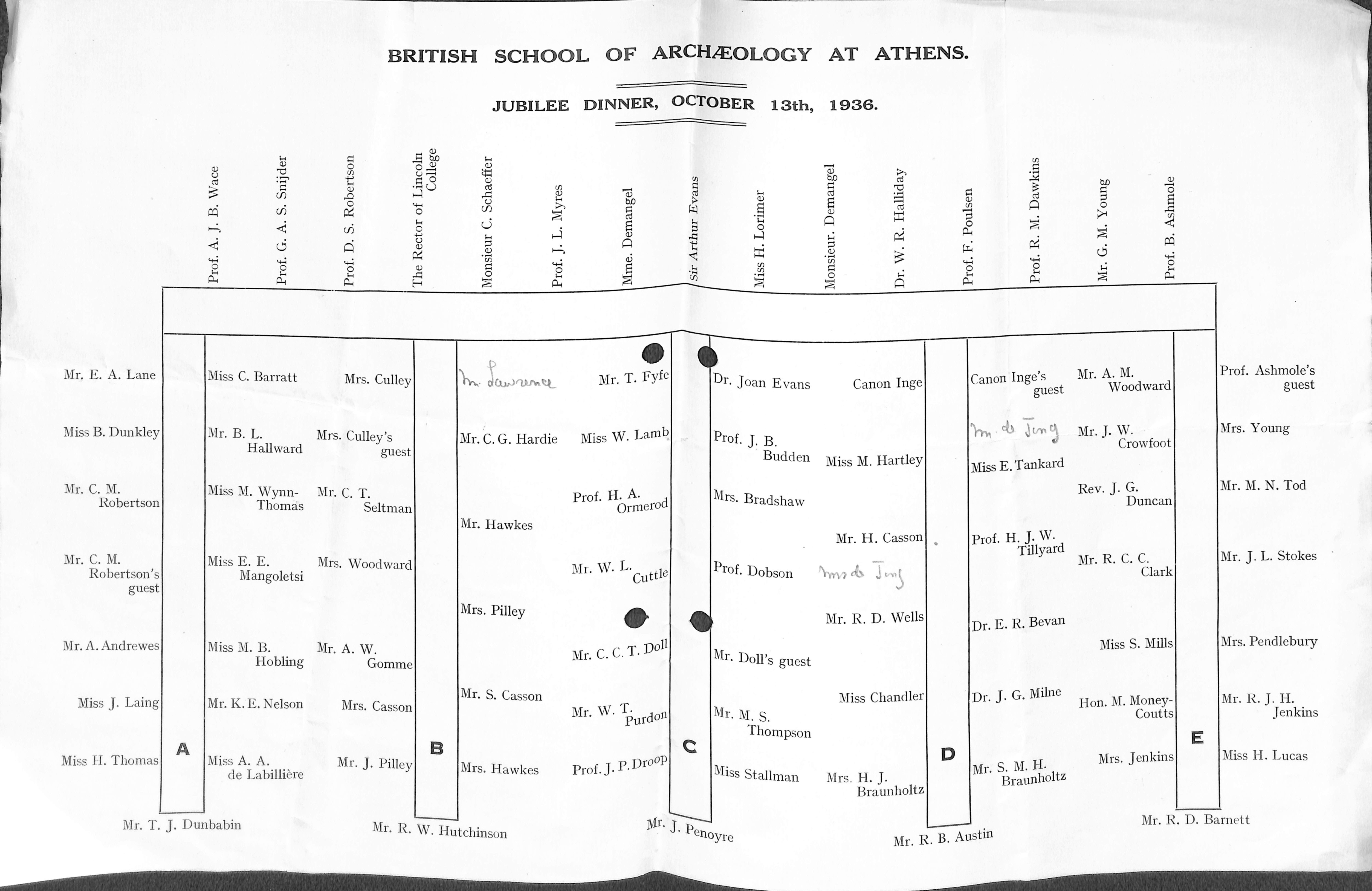
The Duke of Kent was then accompanied by Evans, Llewellyn, and Myres into the Exhibition, whereupon the 300 other guests in attendance followed in intervals, led by stewards such as Mercy Money-Coutts, Miss Joan Laing, Miss Helen Thomas, Miss C. Barratt, and Betsy Dunkley.29 A dinner at 7:00 pm took place at the Princes Galleries, a venue on Picadilly. A ninety-person seating chart of the event showed a great number of archaeologists and BSA Members in attendance. Greek wines and specialty foods were purchased for the dinner from C.A. Connidis (Importer of Greek Foods), and Greek films by John Pilley (University of Bristol) were shown in an adjoining room to add to the jubilant environment.30 The Jubilee Celebrations were only celebrated in London at this time, despite initial plans for a Dinner in Athens, because of the turmoil (as mentioned above) with the BSA’s changing directors. The Exhibition was set to run from October 13th to November 14th, but was extended one week until November 21st because of its success.
The BSA Archives hold an extensive collection of press clippings from the Exhibition news. The show was widely publicised by Myres, Wace, and Evans and was reviewed by other critics, both positively and negatively. The shortest review of the Exhibition argued that the show was ‘serious, important, overcrowded, rather poorly displayed’,31 a sentiment that encompassed the significance of the archaeological work presented, but also captured its disparate organisation resulting from each room of the Exhibition being curated by a different person. Opinion seemed split on the presentation of the Exhibition with one critic arguing that: ‘Without an archaeological friend the casual visitor will be utterly confused’32 while another remarked that ‘It would be hard to imagine a more delightful manner of learning something of the ways of life in early Greece than is provided by the exhibition at Burlington House’.33 It seems that the critiques levelled at the Exhibition focused on the lack of communication about the archaeological history of the sites and the organisation of the Exhibition. One critic noted that the objects displayed were ‘superb’ but ‘Like most purely archaeological shows it is, so to speak, a thing of sherds and patches, a show of fragments or in many cases of copies of original fragments with hypothetical reconstructions adjoining. This game of reconstruction is thrilling to the expert, but meaningless to the layman.’34 Despite some criticism on the display of the show, the reviews praised the archaeological work of Sir Arthur Evans,35 Humfrey Payne36, Winifred Lamb37, and the entire BSA, and reported on the marvel of the artefacts displayed.
The newspapers were fascinated with various notable and awe-inspiring objects in the Exhibition, including the Boy-God ivories and bull-leaping figurine from the Minoan Room, the Spartan bronze figurines and clay house models, the Rampin Horseman cast, and the embroidered textiles from the Byzantine room. The objects that newspapers seemed interested in varied but focused on: the role and appearance of women in the ancient world; the beauty of the artefacts, often compared with the European 'Renaissance’; and religion/cult. These were topics which resonated with the public because they were related to the political and social issues of the 20th century. For example, one article described all the beautiful artefacts and jewelry that early Greek (i.e., Minoan) ‘housewives’ possessed, ‘When she went, with the rest of the fashionable world, to the sacred grove to watch a ceremonial dance she also wore a short-waisted coat with elbow sleeves, her hair hanging loosely to her tiny waist.’38 The similarities of Victorian costume and waists to Minoan female figurine was brought out no less than seven times in different newspaper articles,39 perhaps connected to the reinforcement of feminine roles and beauty in Victorian/Edwardian England. Conversely the focus on the Spartan votive offerings challenged the idea that Spartans were only a military people by emphasising their religious nature: ‘Votive offerings found in the ruins of the sanctuaries there, and other finds, prove that Spartan life was not so strict and severe as formerly believed, but, instead, was similar to the cultures of other big cities at the time. There was a merry Sparta just as there was a merry England.’40 The print media’s fascination with the objects which seemingly related to modernity demonstrated that the Exhibition engaged with contemporary issues of the 20th century.
Aftermath and Legacy
When the Exhibition ended on 21 November, it was estimated that over 11,000 people had viewed it and the BSA had earned £1128 pounds, including all sales of tickets, catalogues, postcards, and books.41 This was an impressive turnout for such a short-term archaeological show, and the BSA made a profit of £200-300 from the show.42 While the show provided great visibility for the BSA’s work, its main goal was the growth of the Appeal Fund. However, the Exhibition did not successfully generate funds as Myres wrote in a letter to Vincent Yorke that ‘He [Sir Arthur Evans] is however disappointed to find that the Exhibition (and especially his own lavish expenditure) did not produce a large response to our Appeal and suggest that the school might do more for Knossos.’43 The BSA was undergoing renovation of the Library and Hostel in Athens in 1937 and it seemed that the lack of funds from the Appeal was a topic of displeasure.44 Perhaps the less than favourable results of the Appeal Funds was a consequence of the economic and political difficulties of the inter-war period and the looming horizon of World War II.
After the Exhibition closed in London on 21 November, the exhibits were dispersed across the UK and Greece, some to their original collections and some donated or sold to museums. All of the Minoan Room’s artefacts, Phylakopi objects from the East Room, and the original Spartan pottery, bronzes, and lead figures were returned to the Ashmolean Museum, with the exception of the Woolley Exhibits which were transferred to the British Museum, the Ivory Head which was returned to Eton College Museum, and the Fitzwilliam Museum Goddess which returned to Cambridge.45 The Spartan Warrior cast was sent to University College London, and the Aphrodite of Lyons and several impressions (nos. 244 and 245 in the Exhibition Catalogue) and drawings (nos. 200, 206, 207, 208, 210, 211, 217, 219) were returned to Athens. Several casts made by Gilléron fils were sold to the Museum of Classical Archaeology at Cambridge, including the Sparta casts (nos. 187, 188, 189, 189, 181, 184), the Rampin Horseman (Head and Body), and the Perachora Casts (nos. 232-260).46
First, however, the Sparta and Perachora casts and bronzes and a number of drawings from the South and West Rooms went to Professor Thomas B. L. Webster at the Manchester Museum for a temporary exhibition in January 1937. According to the newspapers, the Perachora clay temple models, the ivory votive offerings, and the bronze figurines were among the treasures of the temporary exhibition.47 Some of the Manchester Museum objects then moved to Edinburgh for a short two-week exhibition (February 2-13) of the materials in the Minto House. Professor David Talbot Rice planned and oversaw the Edinburgh exhibition, but there were some issues with the organisation of both the Manchester and Edinburgh shows. Alan Wace who was waiting for the Sparta objects at Cambridge was unaware that they were circulated to Manchester for the show, and he had wanted them and the Perachora casts at Cambridge for teaching purposes during term.48 While Myres had promised those objects to Talbot Rice for the Edinburgh exhibition, he had to retract his offer upon Wace’s decision. Only the house models of the Perachora temples (Ashmolean Museum property), a few other objects (Nos. 307-338, 345-356, and 394-399), and the drawings, photographs, and plans of the various rooms were sent to Edinburgh.49 Upon receiving the shipment of materials from London to Edinburgh, however, a mistake had been made by Purdon and his workers when they failed to send about half of the exhibition to Edinburgh.50 The show still opened, but newspaper articles reported that it was mostly illustrative work (i.e., photographs, plans, drawings) of the BSA excavations.51
After the exhibition materials were distributed back to their respective storage places, the BSA was swept up in other administrative and academic responsibilities. Following the death of two of the Directors in 1936 (Humphrey Payne and Alan Blakeway), the year 1937 was busy as School renovations began in Athens and Gerard Young took up his position as Director. Although the Exhibition was not a success for the Appeal Fund, the numbers of visitors and the hundreds of newspaper clippings in the BSA Archive attest to the increased visibility of the BSA’s work. For the BSA and its Members, it was a remarkable synthesis of their excavation work and a highly collaborative project which engaged with scholars from the prehistoric to Byzantine periods, and with Greek officials and museums. For Sir Arthur Evans, it was significant because it was the first comprehensive show on the Minoan civilisation in the UK, perhaps only recently surpassed by the Labyrinth: Myth and Reality exhibition at the Ashmolean Museum. The historical importance of this exhibition has been little discussed in scholarship, with the exception of a few notable blog posts and articles,52 but with the rediscovery of the Exhibition’s labels in the Ashmolean’s Archive and the study of the BSA Archive and Myres Archives (at the Bodleian Libraries), we can further understand the historical and personal forces behind the Exhibition. It is the hope that this project can spark a deeper conversation and research interest in the rich archival record of the Exhibition.
Footnotes
-
“Language No One Can Read, Relics of Crete in London Exhibition, Opening To-Day by Duke of Kent”, Daily Telegraph, 13 October 1936 in BSA Archives (BSA Corporate Records London, Misc. Press Cuttings 1936. Misc. Account Books. Press Cuttings Bundle 1); “Princely Archaeologist”, Yorkshire Post, 28 November 1936 in BSA Archives (BSA Corporate Records London Misc. Press Cuttings 1936. Misc Account Books. Press Cuttings Bundle 1). ↩︎
-
See the Royal Academy’s Exhibition Catalogue for a list of the lectures given. Also documentation of publications that were included in the bookstore are located in BSA Archives (BSA Corporate Records London, Misc., Jubilee (1936) corresp. Misc. Box 1.4.). ↩︎
-
BSA Archives (BSA Corporate Records London, Misc., Jubilee (1936) corresp. Misc. Box 1.4) contains a list of museums, schools, and scholarly institutions that received advertisements and invitations to the Exhibition. ↩︎
-
Managing Committee Unconfirmed Minutes, 12 November 1935. BSA Archives (BSA Corporate Records London, Misc., Jubilee (1936) corresp. Misc. Box 1.4). ↩︎
-
Jubilee Committee Minutes, 3 December 1935. BSA Archives (BSA Corporate Records London, misc., Jubilee (1936) corresp. Misc. Box 1.4). ↩︎
-
Jubilee Committee Minutes, 6 February 1936. BSA Archives (BSA Corporate Records London, Misc., Jubilee (1936) corresp. Misc. Box 1.4). ↩︎
-
Jubilee Committee Minutes, 20 February 1936. BSA Archives (BSA Corporate Records London, Misc., Jubilee (1936) corresp. Misc. Box 1.4). ↩︎
-
Jubilee Committee Minutes, 20 February 1936. BSA Archives (BSA Corporate Records London, Misc., Jubilee (1936) corresp. Misc. Box 1.4). ↩︎
-
Jubilee Committee Minutesm 5 March 1936. BSA Archives (BSA Corporate Records London, Misc., Jubilee (1936) corresp. Misc. Box 1.4). ↩︎
-
Letter from J.L. Myres to R.D. Barnett on 22 February 1936. Myres Archive, Bodleian Library (Oxford), Ms. Myres 43.104. ↩︎
-
Jubilee Committee Minutes, 20 February 1936. BSA Archives (BSA Corporate Records London, Misc., Jubilee (1936) corresp. Misc. Box 1.4). ↩︎
-
Jubilee Committee Minutes, 20 February 1936. BSA Archives (BSA Corporate Records London, Misc., Jubilee (1936) corresp. Misc. Box 1.4); Letters between J.L. Myres to R. Barnett on 21 and 22 February 1936. Myres Archive, Bodleian Library, MS Myres 43.126-127. ↩︎
-
Jubilee Committee Minutes, 3 December 1935. BSA Archives (BSA Corporate Records London, Misc., Jubilee (1936) corresp. Misc. Box 1.4). ↩︎
-
Jubilee Committee Minutes, 6 February 1936. BSA Archives (BSA Corporate Records London, Misc., Jubilee (1936) corresp. Misc. Box 1.4). ↩︎
-
Copy - E. Gillieron fils. BSA Archives (BSA Corporate Records London, Misc., Jubilee (1936) corresp. Misc. Box 1.4). ↩︎
-
Jubilee Committee Minutes, 5 March 1936. BSA Archives (BSA Corporate Records London, Misc., Jubilee (1936) corresp. Misc. Box 1.4); Letter from J.L. Myres to E.J. Forsdyke on 31 August 1936. Myres Archive, Bodleian Library (Oxford), MS Myres 46.39-40. ↩︎
-
Letter from J.L. Myres to R. Barnett on 22 February 1936. Myres Archive, Bodleian Library (Oxford), MS Myres 43.104. ↩︎
-
Letter from J.L. Myres to A. Blakeway on 25 July 1936. Myres Archive, Bodleian Library (Oxford), MS Myres 44.80-81. ↩︎
-
Letter from J.L. Myres to A. Blakeway on 31 August 1936. Myres Archive, Bodleian Library (Oxford), MS Myres 44.80-81. ↩︎
-
Letter from J.L. Myres to A. Blakeway on 25 July 1936. Myres Archive, Bodleian Library (Oxford), Ms. Myres 44.80-81. ↩︎
-
Installation Staff List. SA Archives (BSA Corporate Records London, Misc., Jubilee (1936) corresp. Misc. Box 1.4). ↩︎
-
Letters between D. Payne and J.L. Myres, September 1936. Myres Archive, Bodleian Library (Oxford), MS Myres 48.30-32. ↩︎
-
Customs Letters, October 1936. BSA Archives (BSA Corporate Records London, Misc., Jubilee (1936) corresp. Misc. Box 1.4). ↩︎
-
Transcripts of Opening Ceremony Speech. BSA Archives (BSA Corporate Records London, Misc., Jubilee (1936) corresp. Misc. Box 1.4). ↩︎
-
Transcripts of Opening Ceremony Speech (of Ch. Simopoulos, p. 6). BSA Archives (BSA Corporate Records London, misc., Jubilee (1936) corresp. Misc. Box 1.4). ↩︎
-
See Inaugural October 13th Stewards, BSA Archives (BSA Corporate Records London, Misc., Jubilee (1936) corresp. Misc. Box 1.4). A list of all guests to the opening of the Exhibition is reported in “Greek and Cretan Discoveries: Guests at Opening of Exhibition by the Duke of Kent”, Morning Post, 14 October 1936. BSA Archives (BSA Corporate Records London, Misc. Press Cuttings 1936. Misc Account Books. Press Cuttings Bundle 1). ↩︎
-
Correspondence between C. A. Connidis and Myres and Programme of Dinner. BSA Archives (BSA Corporate Records, London, Misc. Box 4, Jubilee 1911 (dinner), Jubilee 1936). ↩︎
-
Astragal, “Exhibition Tour”, Architects Journal, 22 October 1936. BSA Archives (BSA Corporate Records London, Misc. Press Cuttings 1936. Misc. Account Books. Press Cuttings Bundle 1). ↩︎
-
“They Don’t Know Their A.B.C.s”, Birmingham Gazette, 13 October 1936. BSA Archives (BSA Corporate Records London, Misc. Press Cuttings 1936. Misc. Account Books. Press Cuttings Bundle 1). ↩︎
-
“Greek Life Forty Centuries Ago”, Birmingham Post, 15 October 1936. BSA Archives (BSA Corporate Records London, Misc. Press Cuttings 1936. Misc. Account Books. Press Cuttings Bundle 1). ↩︎
-
“Art in London: Features of Greek Exhibition”, Scotsman, 14 October 1936. BSA Archives (BSA Corporate Records London, Misc. Press Cuttings 1936. Misc. Account Books. Press Cuttings Bundle 1). ↩︎
-
For example see “Digging for 40 Years”, Edinburgh Evening News, 14 October 1936 and “First European Civilisation”, Glasgow Herald, 28 August 1936. BSA Archives (BSA Corporate Records London, Misc. Press Cuttings 1936. Misc. Account Books. Press Cuttings Bundle 1). ↩︎
-
“Solved by an Englishman”, Bournemouth Daily, 30 October 1936. BSA Archives (BSA Corporate Records, London Misc. Press Cuttings 1936. Misc. Account Books. Press Cuttings Bundle 1). ↩︎
-
“Research Work as A Career for Women”, The Queen, 15 October 1936. BSA Archives (BSA Corporate Records London, Misc. Press Cuttings 1936. Misc. Account Books. Press Cuttings Bundle 1). ↩︎
-
“Greek Life Forty Centuries Ago”, Birmingham Post, 15 October 1936. BSA Archives (BSA Corporate Records London, Misc. Press Cuttings 1936. Misc. Account Books. Press Cuttings Bundle 1). ↩︎
-
“Bull-Baiting by the Women of Crete”, Daily Sketch, 13 October 1936; “Art and Fashion in 1700 B.C.: Wasp-Waisted Ladies of Ancient Crete”, Morning Post, 13 October 1936. BSA Archives (BSA Corporate Records London, Misc. Press Cuttings 1936. Misc. Account Books. Press Cuttings Bundle 1). ↩︎
-
“Work in Greece: British School’s Jubilee Celebrations”, Cork Examiner, 18 August 1936. BSA Archives (BSA Corporate Records London, Misc. Press Cuttings 1936. Misc. Account Books. Press Cuttings Bundle 1). ↩︎
-
Results of the Exhibition. BSA Archives (BSA Corporate Records London, Misc. Box 4, Jubilee 1911 (dinner), Jubilee 1936). ↩︎
-
Personal communication with Mark Pomery, Archivist of the Royal Academy, who compared the BSA Exhibition with the eight week 1937 RA show on British Architecture that only brought 8,000 people. A landmark show early in 1936 on Chinese Art, however, brought 400,000 people to the Royal Academy. See Letter from J.L. Myres to Thomas Dunbabin for profit numbers on 12 December 1936. Myres Archive, Bodleian Library (Oxford), MS Myres 45.20-21. ↩︎
-
Letter from J.L. Myres to Vincent Yorke on 13 September 1937. Myres Archive, Bodleian Library (Oxford), MS Myres 51.32. ↩︎
-
Letter from J.L. Myres to Vincent Yorke on 13 September 1937. Myres Archive, Bodleian Library (Oxford), MS Myres 51.32. ↩︎
-
Dismantling and Distribution Schedule. BSA Archives (BSA Corporate Records London, Misc. Box 4 Jubilee 1911 (dinner), Jubilee 1936). ↩︎
-
Dismantling and Distribution Schedule. BSA Archives (BSA Corporate Records London, Misc. Box 4 Jubilee 1911 (dinner), Jubilee 1936). ↩︎
-
“Greek Discoveries in Manchester”, Manchester Guardian, 23 November 1936. BSA Archives (BSA Corporate Records London, Misc. Press Cuttings 1936. Misc. Account Books. Press Cuttings Bundle 1). ↩︎
-
Letter from A. Wace to J.L. Myres on 11 December 1936. BSA Archives (BSA Corporate Records (Steel Case 2, 3.5, London, Letters from 1937) and Letter from J.L. Myres to D. Talbot Rice on 12 December 1936). BSA Archives (BSA Corporate Records, Steel Case 2, 3.5, London, Letters from 1937). ↩︎
-
Letter from J.L. Myres to D. Talbot Rice on 5 December 1936. BSA Archive (BSA Corporate Records, Steel Case 2, 3.5, London, Letters from 1937). ↩︎
-
Letter from W. Purdon to J.L. Myres on 15 February 1936. BSA Archives (BSA Corporate Records, Steel Case 2, 3.5, London, Letters from 1937). ↩︎
-
“Grecian Discoveries: Archaeological Exhibition in Edinburgh”, Edinburgh English News, 2 February 1936. BSA Archives (BSA Corporate Records London Misc. Press Cuttings 1936. Misc. Account Books. Press Cuttings Bundle 2). ↩︎
-
Galanakis, Yannis. 2017. ‘Exhibiting the Minoan Past From Oxford to Knossos’, in Minoan Archaeology, Perspectives for the 21st Century, edited by Sarah Cappel, Ute Günkel-Maschek, and Diamantis Panagiotopoulos, pp. 17-34.; Harlan, Deborah. 2022. ‘1936 Exhibition Season & The British School at Athens’, BSA Stories & News Post, 13 July. https://www.bsa.ac.uk/2022/07/13/1936-exhibition-season/.; Thornton, Amara. 2015. ‘Exhibition Season: Annual Archaeological Exhibitions in London, 1880s-1930s’, Bulletin of the History of Archaeology 25(2), pp. 1-18.; Townsend, Charlotte. 2023. ‘Cataloguing the 1936 Exhibition Collection’, BSA Stories & News Post, 20 December. https://www.bsa.ac.uk/2023/12/20/cataloguing-the-1936-exhibition-collection/.. ↩︎
Bibliography
- Galanakis 2017
- Galanakis, Yannis. 2017. ‘Exhibiting the Minoan Past From Oxford to Knossos’, in Minoan Archaeology, Perspectives for the 21st Century, edited by Sarah Cappel, Ute Günkel-Maschek, and Diamantis Panagiotopoulos, pp. 17-34.
- Harlan 2022
- Harlan, Deborah. 2022. ‘1936 Exhibition Season & The British School at Athens’, BSA Stories & News Post, 13 July. https://www.bsa.ac.uk/2022/07/13/1936-exhibition-season/.
- Thornton 2015
- Thornton, Amara. 2015. ‘Exhibition Season: Annual Archaeological Exhibitions in London, 1880s-1930s’, Bulletin of the History of Archaeology 25(2), pp. 1-18.
- Townsend 2023
- Townsend, Charlotte. 2023. ‘Cataloguing the 1936 Exhibition Collection’, BSA Stories & News Post, 20 December. https://www.bsa.ac.uk/2023/12/20/cataloguing-the-1936-exhibition-collection/.