The following essay gives a brief (archival) history of the creation of the Minoan Room and the how it was reconstructed digitally.
II. The Minoan Room
- Renée Trepagnier, Ashmolean Museum and University of Bristol
Reconstructing the Minoan Room
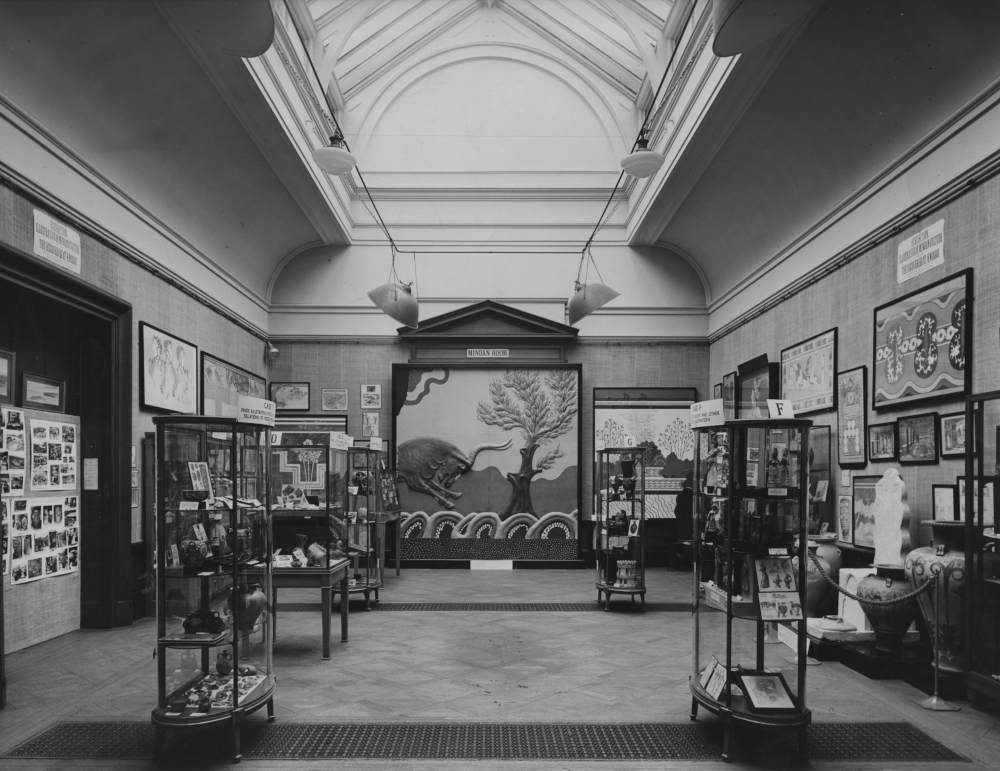
Exhibition Creation and Installation
The Minoan Room (North Room) was a special addition and highlighted feature to the 1936 Exhibition. The year before, Sir Arthur Evans had completed his fourth and final volume of The Palace of Minos, a guide to the excavations at Knossos and the Minoan civilisation on Crete. Evans’s final publication coincided with the Jubilee celebration of the BSA and provided the ideal platform for showcasing a comprehensive history of the Minoan civilisation, as well as providing publicity for the Exhibition. Sir Arthur Evans’s participation in constructing the Minoan Room was pivotal because while the BSA had managed the Knossos properties for ten years, Evans oversaw the excavation, reconstruction and study of the site. He also retained its archives, replicas and objects in his personal collection, alongside the collection of objects from the site he had donated to the Ashmolean Museum (where he was Keeper from 1884 to 1908). When Evans died in 1941, his collection of archives and archaeological objects was bequeathed to the Ashmolean Museum. This explains why reconstructing the Minoan Room relies on documentation and objects from both the Ashmolean Museum and the BSA Archives.
According to the Minutes of the Jubilee Committee in February 1936, Mr. Forsdyke reported that Sir Arthur Evans “viewed Knossos as [BSA] School work” and wished to display his collections alongside the BSA excavation materials.1 Myres wrote that:
Evans quite agrees with the project of using this exhibition and the Jubilee celebration itself to raise an endowment fund for the School; but he would not like the exhibition to be too much dominated by Knossos. I reminded him that the School had also Phylakopi, Psychro, Zakro, Palaikastro, and Mycenae (Wace’s work) to its credits and that if these exhibits were properly marshalled they would be impressive.2
Despite not wanting to dominate the Exhibition, Evans’s section was certainly given special consideration. The Committee followed the request of Evans to host the Exhibition at the Royal Academy’s (RA) Burlington House rather than the originally proposed British Academy, with the reasoning that he had displayed his previous Minoan show there in 1903 and Theodore Fyfe (Evans’s architect) had connections at the RA.3 Furthermore, the Minoan Room was placed in the furthest ‘cul-de-sac’ room of the RA in order to accommodate free-standing artefacts and with “the advantage that that general public will have to traverse the other galleries in order to reach the Minoan exhibit.”4 These archival documents indicate that Evans was a key player in matters of exhibition planning.
In order to prepare the Minoan Room, Evans employed the help of Mercy Money-Coutts and Edith Eccles, two BSA Students who had previously helped organise and catalogue finds for the Stratigraphical Museum at Knossos. In a letter to Myres in August 1936, Evans reports: “Miss Eccles and Miss Money Coutts helped me to sort out specimens … Actual prepare my arrangement in the Slade Lecture Room on Monday next.”5 Evans, Money-Coutts, and Eccles planned and executed a mock-up of the exhibition in Oxford first because the BSA would have had to pay the Royal Academy an additional £50 to set up the exhibition early. Myres wrote, “I have furnished him [Evans] with the scale-drawings of the rooms, and have promised larger ones later on; stressing the importance of having each wall and table case planned on a measured diagram so that the hanging may proceed without pause for deliberation.”6 Diagrams or other curation documents have not been found preserved from the Exhibition, but it is evident that a careful amount of planning took place to anticipate the busyness of exhibition set-up. A July letter between Myres and Blakeway confirms the detailed organization of set-up:
As we do not enter the rooms at Burlington House till October 1 and the exhibit must be completely installed by midday on Saturday Oct 10 (Monday 12th is Press-day), everything will have to be planned and executed elsewhere, for conveyance to Burlington House, and immediate installation, in numerical order, according to the Catalogue, which must be compiled from the material while in preparation or in store, and will be in gallery proof, if not page-proof, before the exhibits are unpacked at Burlington House … Evans’ section is to be planned out at Oxford, and brought up by road.7
The Catalogue was also written before the opening of the show, as confirmed both by the above letter (“the description for the Catalogue will also have to be drafted in advance”) and discrepancies between Evans’s Catalogue entries and the photograph of the Minoan Room. For example, objects are placed on different shelves and in some cases, it is possible that Evans added objects at the last minute, because sometimes significant objects, such as the User statue visible in Case C or Octopus Anchor in Case J, were not mentioned in the Catalogue. Similar to exhibitions today, Evans and his team planned many aspects of the show but altered the placement of objects and exhibition labels during installation.
Evans’s Exhibition Vision
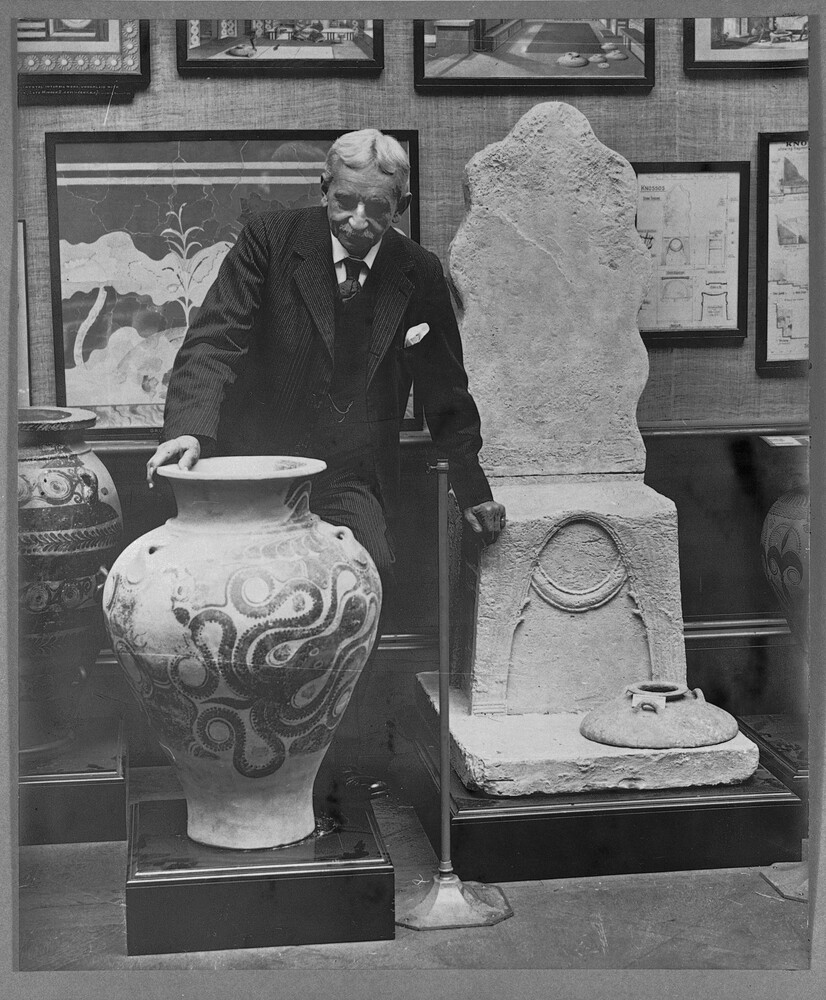
According to Evans’s introduction in the Catalogue, the aim of the Minoan Room was to “supply, as far as possible, the materials for a general survey of the Minoan culture in its widest range”.8 With eleven cases of artefacts, as well as dozens of plans and images on the walls, the Minoan Room contained over 400 objects and illustrations. Many of these objects belonged to the Ashmolean Museum’s collections (donated by Evans and others from excavations) and Evans’s private collection (i.e., sealstones and gold rings) which was eventually donated to the Ashmolean. The room cases were arranged chronologically, starting with the Neolithic and Early Minoan Ages, but also thematically, with certain cases devoted to ritual within the Late Bronze Age or the evolution of Cretan scripts. His introduction in the Catalogue and the lecture he gave to the Royal Academy on 16 October 1936 act as a tour of sorts, providing us with his theories about artefacts in the Minoan Room.
In many ways, as will be evident, Evans’s display of the Minoan civilisation paralleled his Palace of Minos publications. Not only did Evans want to express the same vision of the Minoans that he created in his publications — namely that the Minoans were the first Europeans — but having completed his final volume, he now had in his possession all the physical publication proofs, photographs, drawings and plans. It makes sense, therefore, that he chose materials already printed and prepared for publication to display in the Minoan Room. Most of the exhibition labels are clearly original drawings or mock-ups for figures in the Palace of Minos. Many of the objects on display in the Exhibition also featured in illustrations/figures and discussions in Palace of Minos publications. As a display of objects rather than a four-volume print medium, the Exhibition could more easily compare material culture and concisely lead a viewer through the main practices, beliefs, and craft techniques of the Minoan civilisation. The Exhibition might then be viewed a condensed, three-dimensional version of The Palace of Minos.
Both Evans’s publications and the Exhibition situated Minoan Crete within the wider Eastern Mediterranean culture of the Bronze Age, drawing links between Egyptian, Near Eastern, Mesopotamian, and Anatolian material culture. With comparative material culture, Evans both associated Minoan society with the ‘high cultures’ of other ancient civilizations and emphasised the uniqueness of Cretan culture. Evans’s aim was to demonstrate that Minoan material culture and societal practices mirrored ‘European’ society. His vision has been analysed as a consequence of nationalism, modernity, and imperialism related to contemporary issues affecting the pre- and inter-war periods of the 20th century.9 For example, in both The Palace of Minos and the Exhibition, Evans discussed goddess figurines and signet rings that seemed to anticipate the ‘Adoration of Mother and Child’ in Christianity, emphasizing monotheism and motherhood — two contentious topics of modernity.10 Minoan objects from water pipes to fashionable female hairstyles were lauded as evidence of European culture.11 Newspaper articles in 1936 expanded upon this point by discussing the Royal Academy show in relation to contemporary national issues of repatriation and cultural power. After seeing the Exhibition, T.L. Anthem wrote an article which questioned if “the old controversy about the so-called Elgin marbles will break out afresh”.12 In an article on Belgian neutrality in the aftermath of the First World War, J.A. Spender compared the ‘small nations’ of Crete (“In the ancient world great art and great literature sprang from the small nations.”) and Belgium to argue that “the preservation of small nations is an interest of the highest importance to the civilised world.”13 The Europeanness of Minoan society was detectable in the Exhibition and seemed to resonate with the public.
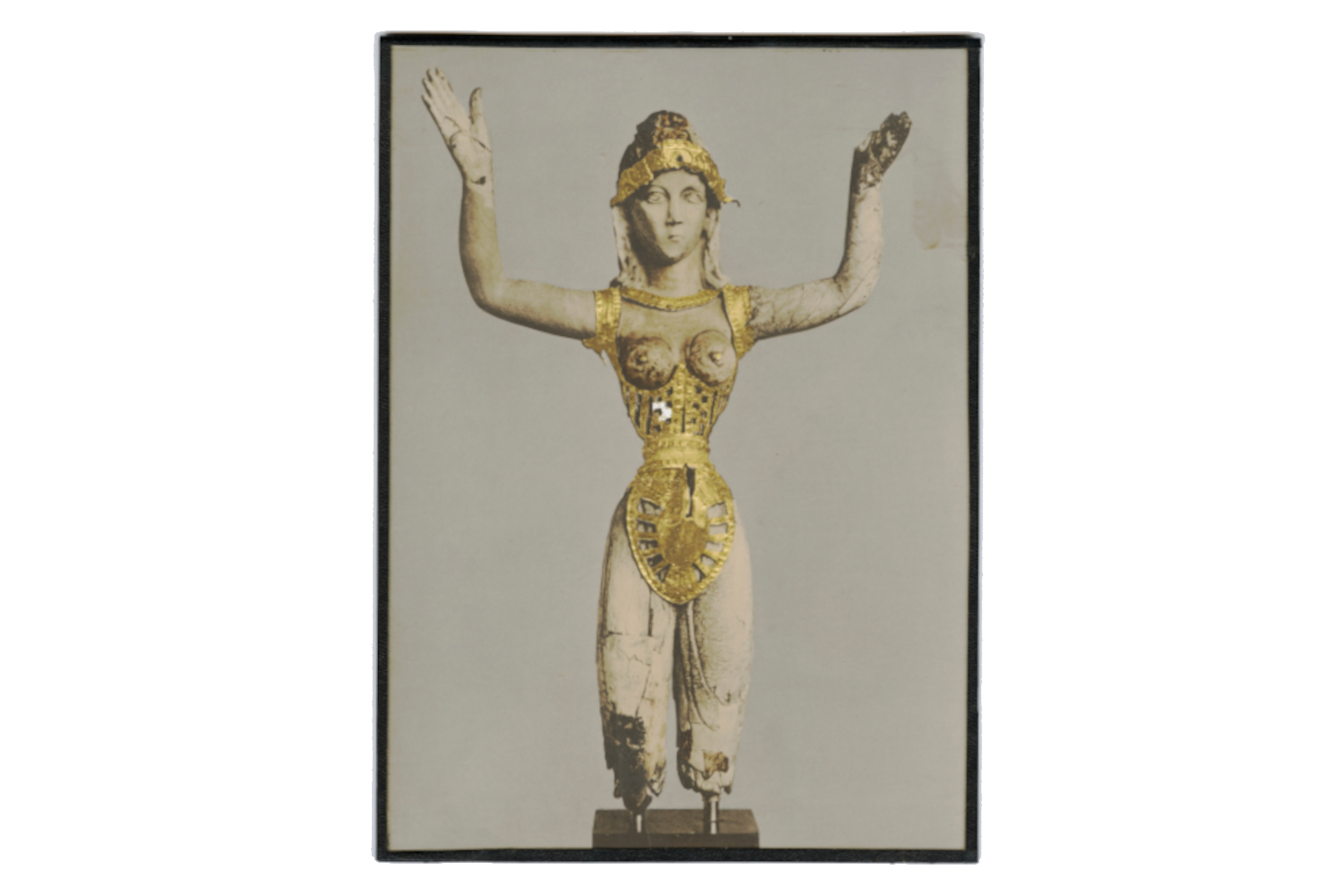
Evans was able to present a comprehensive view of the Minoan civilisation because he was in possession of a great number of replicas, original objects (some of which later turned out to be forgeries) and other material. At the time of the Knossos excavations, a Cretan law prevented artefacts from leaving Crete unless they were not needed for the Cretan museums.14 Replica making became a way for Evans to bring the Minoan civilisation back to England. The father and son artistic duo, the Gilliérons, and artist Halvor Bagge were responsible for many of the replicas in the Minoan Room. Evans also collected sealstones, signet rings, and other objects for his personal collection, sometimes buying artefacts from local inhabitants on his travels around Crete, and others from dealers. During the nearly thirty-year period of excavation at Knossos, forged objects circulated in the antiquities market. Many of the most famous forgeries, such as the the Boston Goddess, the Lady of the Sports, the Body-God, the Fitzwilliam Goddess, and the Thisbe Treasure were displayed in the Minoan Room and validated Evans’s vision of Minoan religion and artistic crafstmanship (see Minoan World essay). The Boy-God was particularly publicised in the newspapers of 1936 as ‘worthy of the Italian Renaissance’ and exemplary of the ancient custom of hair cutting and offering, which Evans linked to Hebraic tradition, Greek mythology, and rituals at Delphi.15 Many of the objects displayed in the Minoan Room contributed to Evans’s overall aim to link Minoan culture with Classical Greek civilisation and European society, even if their provenance and authenticiy were dubious.
Reconstructing the Minoan Room is not only an interesting project in archival research and digital humanities, but it allows us to consider the narrative of the Exhibition and analyse how Minoan artefacts were positioned and interpreted historically. This project focuses on identifying and digitally reassembling the Minoan Room to understand the wider aim and narrative of the display, but possibilities for further research are abundant. It is the hope that this essay sets the stage for future researchers to more deeply analyse the historical contextualisation of the Exhibition and investigate the social, political, and cultural messages projected through the Minoan Room displays.
Method of Reconstruction
Three main resources were used to reconstruct the Minoan Room: The Royal Academy Catalogue of the Exhibition, the BSA Archival photographs of the room, and the Ashmolean Museum’s collection database (including the Sir Arthur Evans Archive). For this project, I also catalogued and digitised a series of framed exhibition labels related to the 1936 Exhibition. Nearly two hundred of these labels were stored in five different boxes in the Sir Arthur Evans Archive. I determined, based on comparisons with the BSA photographs, that most were displayed in the Minoan Room or had matches with objects listed in the Catalogue. At some point in their history, they were likely grouped together because they were all framed in black, some with metal rings on the reverse side for wall hanging. However, it is likely that some of the framed exhibition labels were also used in the historic Aegean Gallery at the Ashmolean or were considered for exhibition but never displayed. In addition some exhibition labels have been lost/destroyed or re-integrated into other sections of the Archive without frames. There are at least five labels visible in the BSA photograph of the Minoan Room that have not yet been located in the Evans Archive. I have also rediscovered exhibition labels that are visible in the photograph (Drawing of Bronze Bowl with Foliate Decoration from Palatial Hoard) and found potential other images that were either in the Exhibition or considered for display (e.g. Comparative Knossos and Delphic Omphalos and Drawing of Donkey as Pack Animal from Phaistos). These archival challenges demonstrate that the process of reconstructing the Minoan Room is not straightforward and requires some guesswork. In this publication only objects that were almost certainly in the exhibition are included in the catalogue, with weblinks provided for less certain examples. All framed labels are included in the catalogue but with an indication of whether they have been associated with a particular showcase or not.
Knowing that the objects of the Minoan Room came from the Ashmolean Museum’s collections, I used the Catalogue, the BSA photographs, and the Museum’s database to find object matches. Sometimes this was easy because an object was clearly described in the Catalogue or visible in the photograph. Other times, when descriptions were quite vague, I searched the Palace of Minos publications to see if illustrations in the publication gave some guidance to what types of ‘barbotine’ ware cups, for example, Evans might have displayed. Exhibition labels could sometimes be matched to Catalogue descriptions, but I also guess as to which exhibition labels might have been included based on the theme and chronology of the Case. For example, although you can only see one exhibition label in Case A, there are at least six other exhibition labels that relate to EM I and II objects and themes present in the Case. The Palace of Minos is also a good tool for determining the possible Case location of exhibition labels because it is likely that the same illustrations/figures in the Exhibition were grouped under chronological and thematic topics within the publications. When object descriptions are too vague, objects and labels are hidden in the photograph, or labels are missing there is lacuna of information, but overall, this methodology has worked to determine as much as possible, the objects and exhibition labels that would have been on display in the Minoan Room. To give a more complete picture of the Minoan Room, I make suggestions (when appropriate) of objects or labels which might have been similar to the ones displayed.
Footnotes
1 Jubilee Committee Minutes, 6 February 1936. BSA Archives (BSA Corporate Records London, Misc., Jubilee (1936) corresp. Misc. Box 1.4).
2 Letter from J.L. Myres to R.D. Barnett on 1 January 1926. BSA Archives (Steel Case 2, 3.3: London Letters from 1936).
3 Letter from J.L. Myres to R.D. Barnett on 1 January 1926. BSA Archives (Steel Case 2, 3.3: London Letters from 1936); Jubilee Committee Minutes, 6 February 1936. BSA Archives (BSA Corporate Records London, Misc., Jubilee (1936) corresp. Misc. Box 1.4).
4 Letter from J.L. Myres to R.D. Barnett on 22 February 1936. Myres Archive, Bodleian Library (Oxford), Ms. Myres 43.104.
5 Letter from A.J. Evans to J.L. Myres on 11 August 1936. BSA Archives (Misc. Box 4, Jubilee 1911 (dinner), Jubilee 1936).
6 Letter from J.L. Myres to R.D. Barnett on 22 February 1936. Myres Archive, Bodleian Library (Oxford), Ms. Myres 43.104.
7 Letter from J.L. Myres to A. Blakeway on 15 July 1936. BSA Archives (Managing Committe Minutes and Agenda 1920-1939).
8 Evans, Arthur. 1936. ‘Exhibition Illustrative of Minoan Culture with Special Relation to the Discoveries at Knossos’, in British Archaeological Discoveries in Greece and Crete 1886-1936, edited by John Myres. London: Royal Academy of Arts, pp. 5-33.
9 See Hamilakis, Yannis and Momigliano, Nicoletta, 2006. Archaeology and European Modernity: Producing and Consuming the ‘Minoans’. Padua: Bottega d’Erasmo., Papadopoulos, John. 2007. ‘Inventing the Minoans Archaeology, Modernity and the Quest for European Identity’, Journal of Mediterranean Archaeology 18(1), pp. 81-149., and Schoep, Ilse. 2018. 'Building the Labyrinth: Arthur Evans and the Construction of Minoan Civilization, American Journal of Archaeology 122(1), pp. 5-32..
10 Evans, Arthur. 1930. The Palace of Minos at Knossos, III. London: Macmillan. and Morris, Christine. 2006. ‘From Ideologies of Motherhood to Collecting Mother Goddesses’, in Archaeology and European Modernity: Producing and Consuming the ‘Minoans’, edited by Yannis Hamilakis and Nicoletta Momigliano, pp. 69-78.
11 Evans, Arthur. 1930. The Palace of Minos at Knossos, III. London: Macmillan. and Evans, Arthur. 1930. The Palace of Minos at Knossos, III. London: Macmillan.
12 Anthem, T.L, “Magic of the Parthenon,” Liverpool Echo, 9 October 1936 in BSA Archives (BSA Corporate Rec. London Misc. Press Cuttings 1936. Misc Account Books. Press Cuttings Bundle 1).
13 Spender, J.A, “Belgian Neutrality: The Importance of Little Nations”, Birmingham Gazette, 20 October 1926 in BSA Archives (BSA Corporate Rec. London Misc. Press Cuttings 1936. Misc Account Books. Press Cuttings Bundle 1).
14 Panagiotaki, Marina. 2004. ‘Knossos objects: 1904, the first departure’, in Knossos: Palace, City, State, edited by Gerald Cadogan, Eleni Hatzaki and Andonis Vasilakis. London: British School at Athens, pp. 565-580.
15 Evans, A.J., “Minoan Culture Displayed at the Royal Academy”, Illustrated London News, 7 November 1936 in BSA Archives (BSA Corporate Rec. London Misc. Press Cuttings 1936. Misc Account Books. Press Cuttings Bundle 1). and Evans, Arthur. 1935. The Palace of Minos at Knossos, IV. London: Macmillan..
Bibliography
- Evans 1930
- Evans, Arthur. 1930. The Palace of Minos at Knossos, III. London: Macmillan.
- Evans 1935
- Evans, Arthur. 1935. The Palace of Minos at Knossos, IV. London: Macmillan.
- Evans 1936
- Evans, Arthur. 1936. ‘Exhibition Illustrative of Minoan Culture with Special Relation to the Discoveries at Knossos’, in British Archaeological Discoveries in Greece and Crete 1886-1936, edited by John Myres. London: Royal Academy of Arts, pp. 5-33.
- Hamilakis and Momigliano 2006
- Hamilakis, Yannis and Momigliano, Nicoletta, 2006. Archaeology and European Modernity: Producing and Consuming the ‘Minoans’. Padua: Bottega d’Erasmo.
- Morris 2006
- Morris, Christine. 2006. ‘From Ideologies of Motherhood to Collecting Mother Goddesses’, in Archaeology and European Modernity: Producing and Consuming the ‘Minoans’, edited by Yannis Hamilakis and Nicoletta Momigliano, pp. 69-78.
- Panagiotaki 2004
- Panagiotaki, Marina. 2004. ‘Knossos objects: 1904, the first departure’, in Knossos: Palace, City, State, edited by Gerald Cadogan, Eleni Hatzaki and Andonis Vasilakis. London: British School at Athens, pp. 565-580.
- Papadopoulos 2007
- Papadopoulos, John. 2007. ‘Inventing the Minoans Archaeology, Modernity and the Quest for European Identity’, Journal of Mediterranean Archaeology 18(1), pp. 81-149.
- Schoep 2018
- Schoep, Ilse. 2018. 'Building the Labyrinth: Arthur Evans and the Construction of Minoan Civilization, American Journal of Archaeology 122(1), pp. 5-32.