The essay is constructed to take the reader through the Minoan Room as if they were a visiting guest to the Exhibition. The objects and exhibition labels which were on display have been identified using photographs of the Exhibition and printed catalogue entries. Because of the incomplete photographic record and sometimes vague descriptions of the objects in the printed catalogue it has not been possible to identify every item. The description of the case/wall is followed by the printed catalogue entries written by Sir Arthur Evans. Links to objects and exhibition labels which were definitely used in the Minoan Room are included throughout the essay. Other possible labels and objects are discussed in the introductory texts. The printed catalogue also includes an introduction section which is available, along with the entries for the other rooms of the Exhibition, from the Royal Academy.
III. The 1936 Exhibition Catalogue and Added Descriptions
- Andrew Shapland, Ashmolean Museum
- Renée Trepagnier, Ashmolean Museum and University of Bristol
THE MINOAN ROOM
Walking into the Exhibition
When one entered the Minoan Room, large framed plans, maps, and photographs covered the walls to the left and right of the entrance. These are not visible in any of the BSA photographs, but their descriptions in the printed catalogue give some idea of their presentation. It has not been possible to identify specific items in the Sir Arthur Evans Archive which relate to these descriptions because they could refer to multiple items.
On walls at either side of Entrance.—Plans of Knossos:—
To right on entering.—Large Plans of the Palace, including more recent discoveries; Western Enceinte and Entrance System, and Domestic Quarter, with Sections of Grand Staircase; beyond, Tomb of Double Axes, Royal Tomb of Isopata and Temple Tomb.
To left on entering.—Plan and Isometric View of the Little Palace. Plans of Town Houses; beyond, Sections of ’ Royal Road,’ and plan and section of Cistern at Arkhanes, with vaulting of tholos-like construction. Photographs of the Site and details of structures. Section of Minoan floor-levels under West Court of Palace, with stratification of the vast underlying Neolithic deposit.
Neolithic Origins
As there is no photographic evidence or detailed descriptions for this case, it not clear which exact figurines and sherds would have been displayed, but the Ashmolean’s collection holds a few Neolithic figurines and it is probable that this complete figurine from Knossos illustrated some of the common characteristics of such figures. Some of the sherds displayed were probably a variety of burnished and incised ware, not unlike this burnished sherd with incised decoration and white pigment. Regardless of the specific pieces chosen, this small case would have given a general idea of the material culture of Neolithic Knossos. It is possible that five exhibition labels related to Neolithic materials were present in the case as well: ‘Clay Idols and Stone Derivatives’, ‘Neolithic Stone Tools and Figures’, ‘Neolithic Vessels and Tools’, and ‘Neolithic Artefacts including figures’, and ‘Stone Figurine’.
In small case, a selection of Neolithic sherds and rude clay idols.
Wall Case A
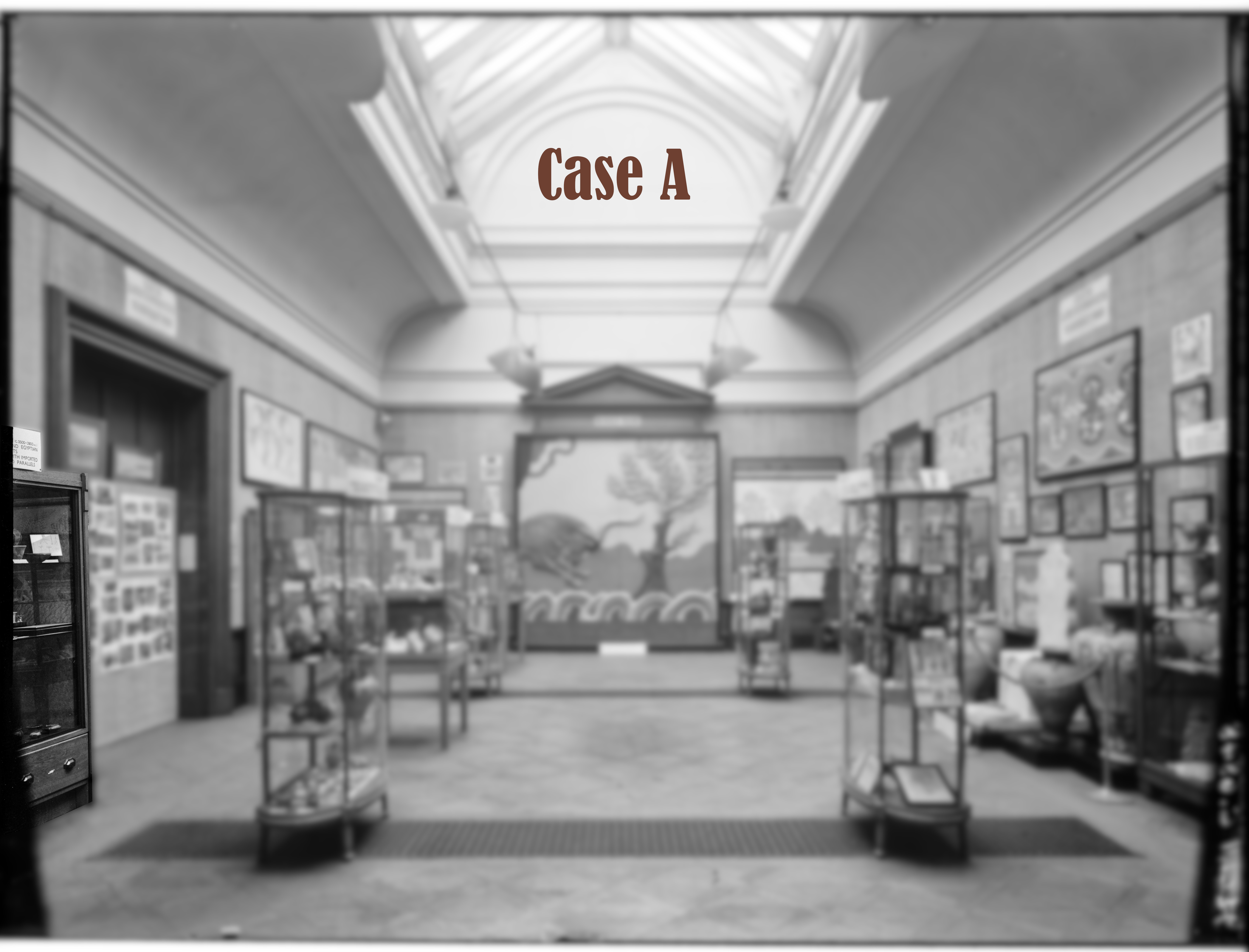
Wall Case A is partly visible in the furthest lefthand section of the photograph. It was devoted to the Early Minoan I and II periods, which Evans dated to 3500–2400 BCE. Several objects listed in the printed catalogue can be identified in the Ashmolean’s collection, some of which are partly visible in the photograph: for example, an imported Cretan stone vase, a replica of the “mottled toilet vessel imitating diorite”, and two Vasiliki Ware vases, one of which appears to be a replica. One label (‘Gold Jewels of Floral and Foliate Types from Mochlos’) was clearly visible in the photograph. Six different labels seem to match the descriptions of items given in the printed catalogue (see below). It is possible that the following exhibition labels were also displayed in the case: ‘EM II Vessels showing metallic forms’ and ‘Terracotta Flower’.
WALL-CASE A.-EARLY MINOAN I, II. Bottom Shelf
Late Predynastic and Early Dynastic vases, and imported Cretan examples [1], [2] (from c. 3500 B.C.). Middle Shelf (same continued).
Late Predynastic cupped libation block, from Hierakonpolis, with clay version: Comparative Group A.
Imported cupped block of igneous rock from Temple Tomb, Knossos, with later imitative examples [1], [2] from primitive ossuaries, Messara.
Late Predynastic stone palettes1 and Cretan derivatives. Group B. Label
Late Predynastic images and Cretan derivatives [1], [2], [3]. Group C. Label
Early Minoan stone vessels; the influence of Proto-dynastic Egyptian spouted copper vessels is to be noted. Group D. Label
Fourth Dynasty moustache-cup of alabaster, and marble imitation from Knossos. Group E. Label
Carinated translucent diorite bowl; Tomb of Kamena (Fourth Dynasty, c. 2800 B.C.), and fragments of similar bowls, from Knossos.
Fragment of similar bowl in liparite, a form of obsidian imported from the Aeolian Islands and worked by Knossian lapidaries for similar bowls. Facsimile.
Facsimile of mottled marble toilet vessel (imitating diorite), identical in form with one from E.M. II tomb, Mochlos, and paralleled by another, with inscription of 16th year of Pepi I (c. 2486 B.C.). Label
Lid of E.M. II pot (Mochlos), with high relief in singularly free style, showing native dog, a remarkable example of early sculpture.
Illustrations of E.M. II jewellery with flowers and leaves. Label
VASILIKI MOTTLED WARE(E. Crete): imitation of early dynastic Egyptian spouted vessel in copper.
Upper Shelf
Between Case A and Case B
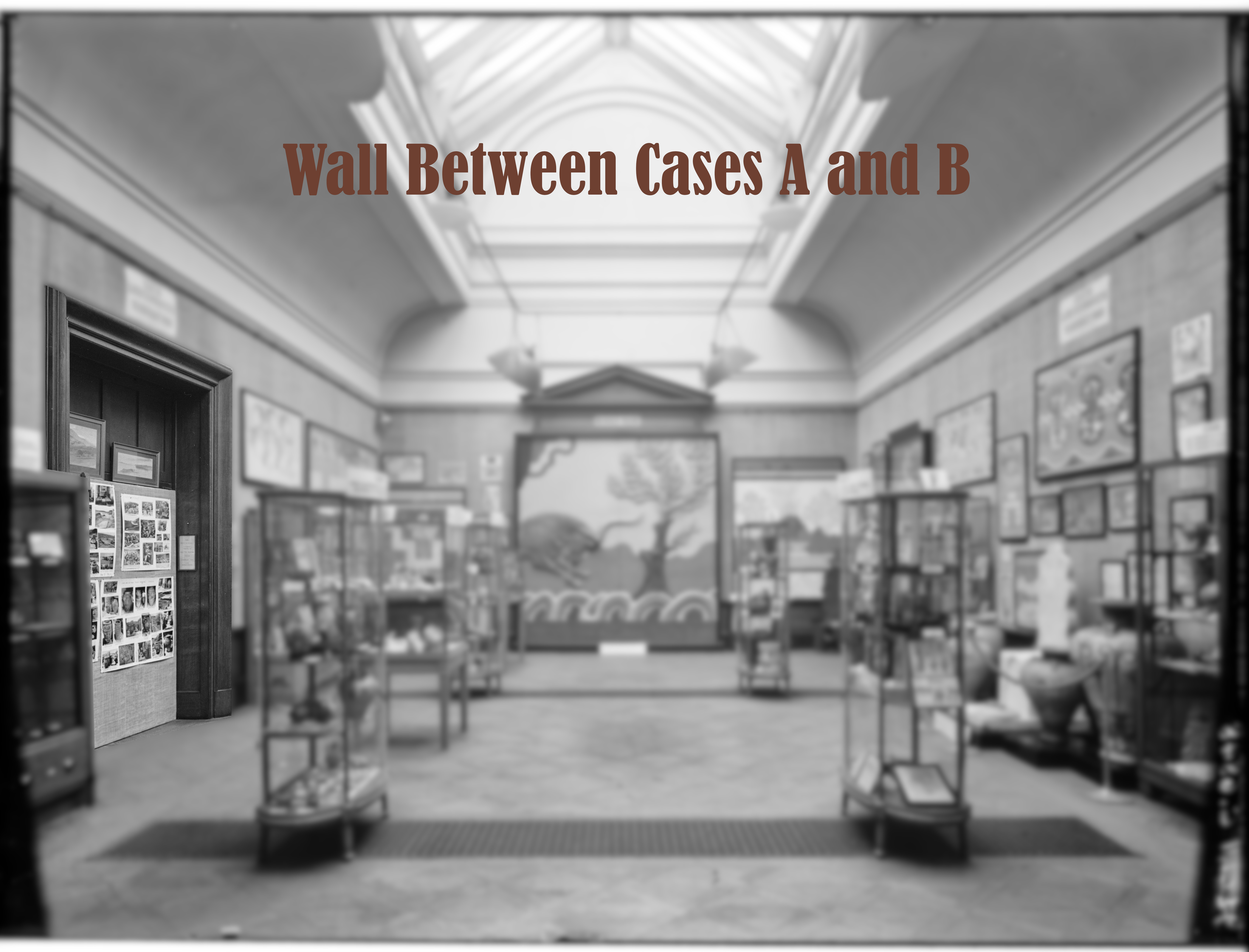
The wall space between Case A and Case B was also used to display photographs of the Knossos excavations and paintings of Cretan scenes on boards. The complete boards are not preserved in the Ashmolean collection but some photographs do appear to have been ripped off similar boards. Some of the images are identifiable from the photograph, including Theodore Fyfe and Cretan Workmen, Workmen on the Grand Staircase, and Caravanserai. Images of large pithoi (storage vessels) also highlighted artefacts that were obviously too large to be displayed in the Exhibition: West Magazine 11, East Magazines, Ioannis Papadakis and a Pithos. The two watercolour drawings by Edward Lear are also visible in the photograph. These were owned by Sir Arthur Evans and later donated to the British School at Athens.
On Wall between Cases A and B
TWO WATER-COLOUR DRAWINGS of the neighbourhood of Knossos, by Edward Lear: (1) View of Mount Juktas showing the village of Sylamos in foreground (1864). (2) Candia (Megalokastron), showing Venetian ramparts of the sea-front (1864).
PHOTOGRAPHIC VIEWS: (3) Workmen on the excavation. (4) The Palace: southern and western enceinte and environs.
Wall Case B
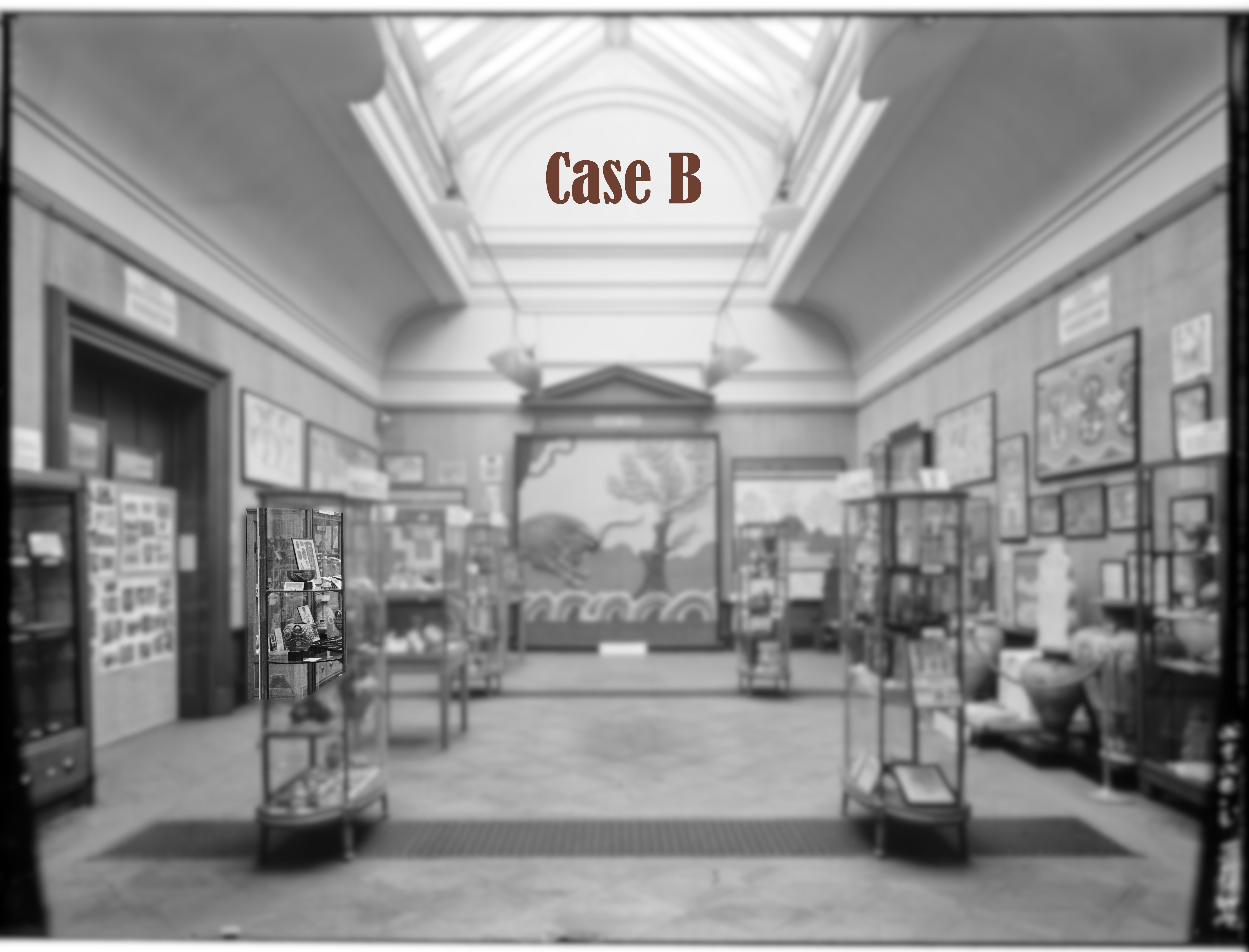
Wall Case B was located on the same wall as Case A, but it is barely visible in the photograph. Only through the glass of Case C can a few objects and labels be seen. The case was dedicated to the Early Minoan III to Middle Minoan IIB periods (2400–1700 BCE). It contained a great deal of pottery in a variety of styles (i.e., ‘barnacle ware’, ‘barbotine ware’, monochrome, polychrome, etc.), but it is difficult to identify the specific pieces on display. Some objects listed in the printed catalogue are discernible: two vessels (an Early Minoan III spouted pot and a jar with triple group of palm trees) and two other artefacts (Gypsum Round Table and facsimile of Mallia Bee Pendant). Although not mentioned in the printed catalogue, in the photograph a votive ‘cow-bell’ and ‘barbotine’ ware cup, are visible on the upper shelf. Several exhibition labels match descriptions in the printed catalogue. The exhibition labels ‘Wall Pattern Nature Printed with Small Sponge on Stick’ (see below) and ‘Silver Vase and Ceramic Imitations of Metal Forms’ are barely visible on the middle shelf of the case. It is possible that several other exhibition labels related to Early Minoan III to Middle Minoan IIB were displayed in this case: ‘Seal from Agia Triadha and Jug from Kamares Cave’, 'MM IA Pottery from House A and B Beneath Koulouras’, ‘Vessel for Filtering’, and ‘Floral Patterns of a Textile Character on MM IB Pottery’. The labels ‘MM II Polychrome Vases Illustrating Earlier Palace Style’, ‘Rhytons in the Form of Bulls with Acrobatic Figures’, ‘Bronze Daggers from Tholos at Hagia Triada’, ‘Clay Idols Showing MM I Skirts’, ‘Vat Room Deposit Materials’, and ‘EM III Larnakes’ were possibly in the case as well. Labels ‘Griffins’, ‘Lintels of Mycenae and Kumasa’, ‘Primitive Beehive Tombs’ may have been either Case A or Case B.
To the left of Case B, three exhibition labels hung on the wall, one of which was ‘View of the Megaron of the Royal Villa from the East End’, which did not relate to the contents of Case B but, like other items on the wall, highlighted Knossian architecture. The other was likely ‘Reconstruction of the House of the Chancel Screen at Knossos’.
WALL-CASE B.-EARLY MINOAN III: MIDDLE MINOAN IIB.
Upper Shelf, left.
EARLY MINOAN III. Pottery with white-on-black decoration:
Spouted pot with red white-bordered stripes: earliest example of polychromy, Knossos 1894.
Upper Shelf, right.
SECTION OF ROUND TABLE in purplish gypsum from an early house floor, with the earliest known example of architectonic moulding.
MIDDLE MINOAN I. Monochrome, early polychrome, and ‘barnacle’-ware: see, too, votive figures from Palaikastro (East Room, No. 99).
Middle Shelves, left.
MIDDLE MINOAN Ib. Polychrome pottery and ‘barbotine’ or ‘prickle’-ware: plant-designs showing textile influence, evidences of ‘nature-printing’ from sponges on plaster also copied on vases. Label
Designs of wild goats, herons, and water-beetles, and vase-relief of cockchafer. Label
Facsimile of pendant gold jewel, consisting of two hornets and globes with miniature granulation; from excavations of the French Mission at Mallia; an unique example of the skill attained by Minoan jewellers: c. 2000 B.C. Middle Shelves, right.
MIDDLE MINOAN IIa: for fine ’ egg-shell’ ware, see Case E opposite.
Bottom Shelf.
MIDDLE MINOAN IIb. Polychromy already decadent. Large jar with triple group of palm-trees from ‘Loom-weight’ deposit (with section showing stratigraphy).
‘Loom-weight’ deposit (with section showing stratigraphy). Label
Small vessels, probably votive, white-on-black technique: transitional to M. M. III: see Wall-Case H.
Wall Around Case B
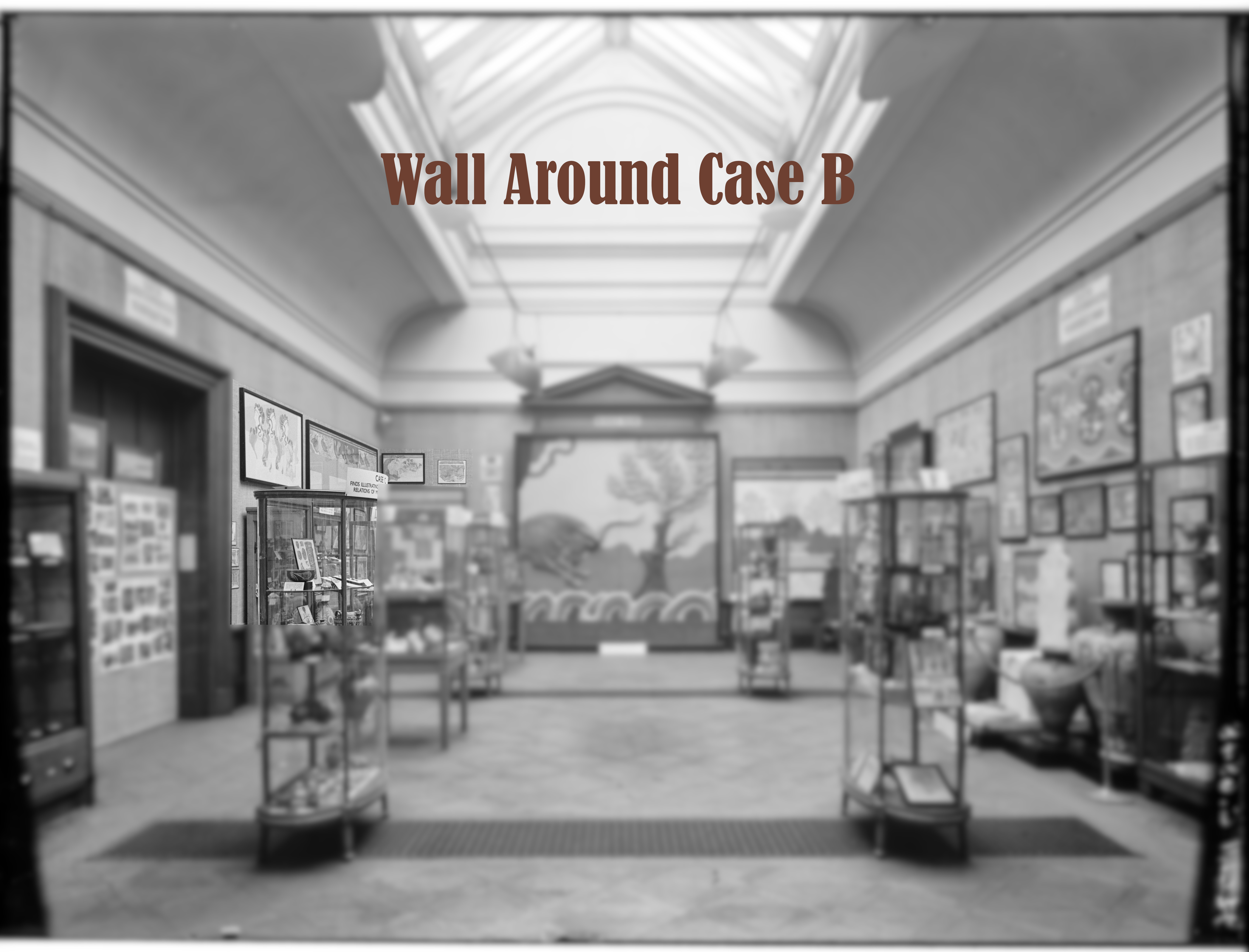
On the wall surrounding Case B several fresco copies were displayed. It is possible to see the large Ladies in Blue fresco and the Partridge Frieze from the Caravanserai on the upper part of the wall. Through the glass of Case C and B other framed frescoes are visible, probably including those mentioned in the printed catalogue: Child Putting Saffron Flowers in Baskets, Spiral Frescoes, the Miniature Frescoes (Sacred Grove and Dance, and the Temple and Grand Stand), Blue Monkey in rocky landscape with ‘sacral ivy’, and Blue Roller among rocks. In the printed catalogue it is recorded that the Charging Bull on a Crystal Plaque was on this wall, but rather it is visible (in a large frame like the other wall copies) on the lowest shelf of Case F in the immediate foreground. Two other fresco specimens from the House of the Frescoes are visible on the End Wall (Monkey Hunting Among Papyrus and another depicting a river—see ‘Specimens from House of Frescoes’) above the frescoed lily panel from Amnisos. The ‘Miniature Frescoes of Seated Ladies on Grand Stand’ may have hung on the wall as well. The rest of the wall illustrations, including the plaster Charging Bull, are discussed in a separate section below.
On wall above Case B and to right of it.
CHILD PUTTING SAFFRON FLOWERS INTO BASKETS: Head restored, probably a girl; from rocks around sprout similar flowers. The blue convention for the body colour, and the character of the black and red veining of the rock-sections, as well as the style of some of the crocus-flowers are abnormal, and the work is clearly earlier than any other more or less complete piece of fresco preserved.
M.M. IIIa.
THE LADIES IN BLUE: Toilette scenes were much in vogue in the Palace at this epoch; 17th century B.C. Above Case B.
SPIRAL FRESCOES: (1) (above) found above Loom-weight Basement; (2) (below) found beneath floor of Magazine with ‘Medallion Pithos’; both beneath M.M. IIIb deposits. On Wall
M.M. IIIb.
MINIATURE PAINTING OF A CHARGING BULL on the back of a crystal plaque; of microscopic work, enlarged.
MINIATURE FRESCOES: (1) The Sacred Grove and Dance. (2) Temple and Grand Stand, thronged with spectators of sports; the seated ladies in fashionable costume, of the front row of the stand, supply an extraordinarily modern touch. See, too, Case H. The M.M. IIIb date is stratigraphically determined, the first half of the 16th century B.C.
SPECIMENS FROM THE ‘HOUSE OF THE FRESCOES’: M.M. IIb and transitional L.M. Ia.
Blue Monkey in rocky landscape, with ‘sacral ivy’ and compound papyriform flowers.
Blue Monkey (West African ‘Green Monkey’) hunting among papyrus.
Blue Bird (Roller) rising from rocks with wild roses, Pancratium lily, iris, and vetches: clumps of crocus flowers.
Blue Monkey amidst papyrus, in a later style, perhaps L.M. Ia.
End Wall.
FRIEZE OF PARTRIDGES from the ‘Caravanserai,’ Knossos: transitional style.
Upper Wall space
Standing Case C
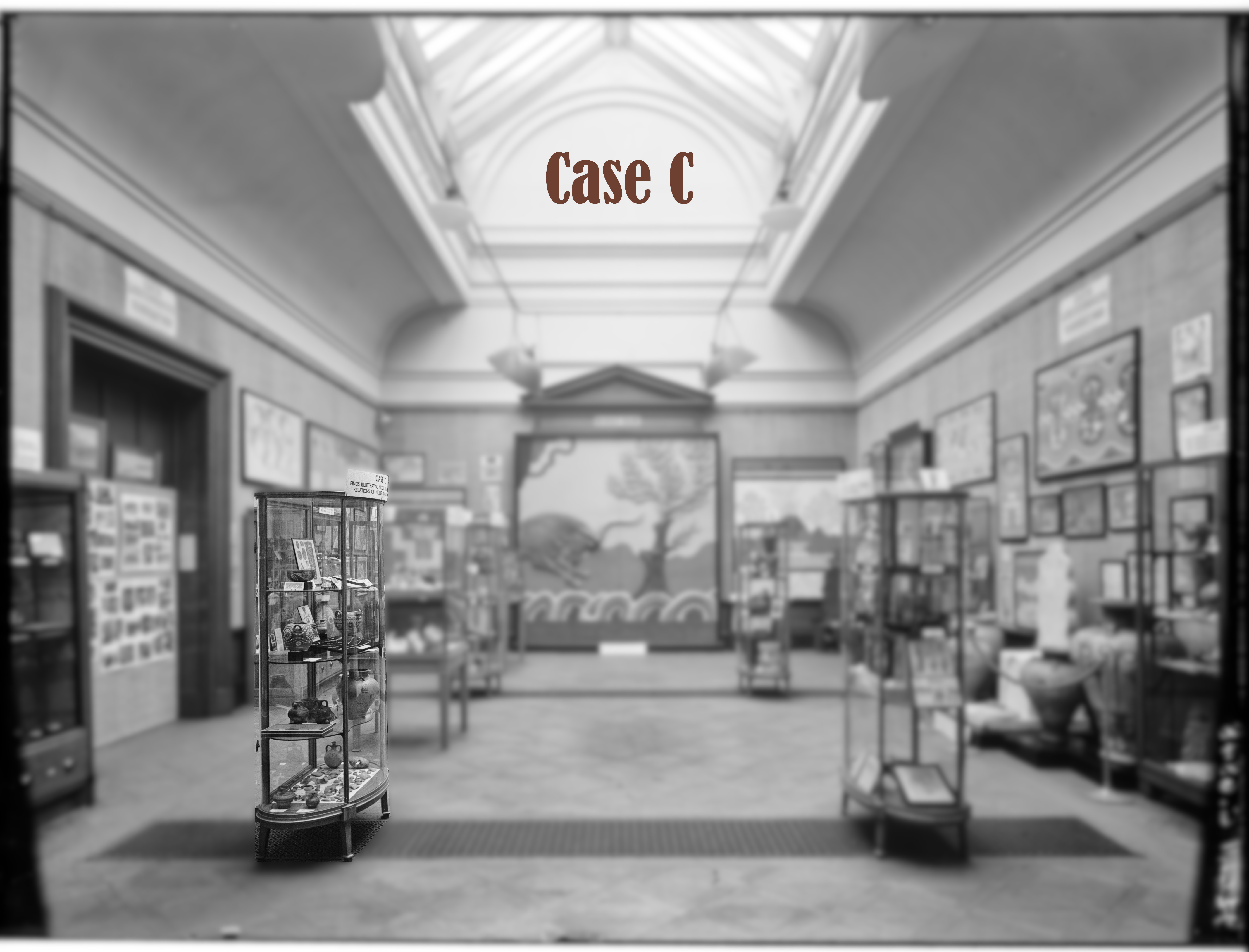
Standing Case C is fully visible in the foreground of the left section of the photograph. It was dedicated to displaying finds related to the Middle Kingdom Egyptian relations of MM IIA and IIB (1900-1700 BCE). The printed catalogue only has four entries for this case, but it is clear from the photograph that many more sherds and objects were displayed than described. The upper shelf contained the Polychrome ‘egg-shell’ ware bowl with bat-and-ball motif, a replica of the statue of User and a label Inscriptions on Figure of User, a series of sherds from Harageh, Egypt (see Evans, Arthur. 1928. The Palace of Minos at Knossos, II. London: Macmillan.) and a polychrome sherd with bat-and-ball motif from the Theatral Area with the accompanying label (see below). There is also a (missing) exhibition label featuring a polychrome jar from the SE Deposit that is illustrated in the Palace of Minos (Evans, Arthur. 1928. The Palace of Minos at Knossos, II. London: Macmillan.).
The shelf below contains the Abydos Cemetery deposit (and a label-see below), which includes the bridge-spouted jar, blue glaze hedgehog, faience vase, and various jewellery pieces. A Knossian bridge-spouted jar was compared to the Abydos one. The printed catalogue did not list any objects from the lower two shelves beyond remarking that it was New Kingdom and Late Minoan Pottery but by looking at the photograph one can see a Late Helladic amphora found in Thebes and its corresponding label ‘Amphora from Egyptian Thebes’, the exhibition label ‘Griffin on Axe Blade’, and (through the reflection of the glass) a Cretan alabastron found in Egypt and a comparison label ‘Clay Alabastron from Mochlos’. Several stirrup jars and ‘pilgrim flasks’ are visible on the bottom shelf, along with an assemblage of sherds. It is possible that ‘Segmented Types of Faience Beads’ was also in the case.
STANDING CASE C.-FINDS ILLUSTRATING THE MIDDLE KINGDOM EGYPTIAN RELATIONS OF MINOAN IIA AND IIB.
Upper Shelf
POLYCHROME CRETAN SHERDS (M.M. IIa) from Harageh, of Senusert II’s time (c. 1906-1888 B.C.): found by Mr. R. Engelbach. These include (1) a fragment of ‘barbotine’ ware of a type ascribed to the close of M. M. IIa. (2) Part of a spout with rivet-head, showing metal work origin. (3) An unique form of strainer. (4) A small fragment showing part, of the ‘tennis-bat-and-ball’ pattern, white on black; specially important from the Knossian comparisons beside it. (SEE PM II, 212, fig. 119)
POLYCHROME Bowl of ‘egg-shell’ ware showing same bat-and-ball motive (reconstructed from fragments associated with the Royal Pottery Stores, Knossos): for example of similar bowl, see annexed illustration of polychrome jar from S.E. Deposit (Candia Museum).
POLYCHROME FRAGMENT found in the Second Stratum beneath the tenth step of the Theatral Area, Knossos (just above the M.M. I layer: see drawing of section), showing part of the same bat-and-ball motive. Label
Second Shelf.
POLYCHROME BRIDGE-SPOUTED POT (M.M. IIb) found in a tomb of Abydos Cemetery by Professor J. Garstang with Twelfth Dynasty Amenemhat III (c. 1849-1801 B.C.). Some of the associated Egyptian relics are here shown; among them a hedgehog and vase in fine blue glaze-ware. Label
Lent by the Ashmolean Museum.
[For the associated New Kingdom and Late Minoan pottery on the bottom shelf, see under Case D.]
Standing Case D
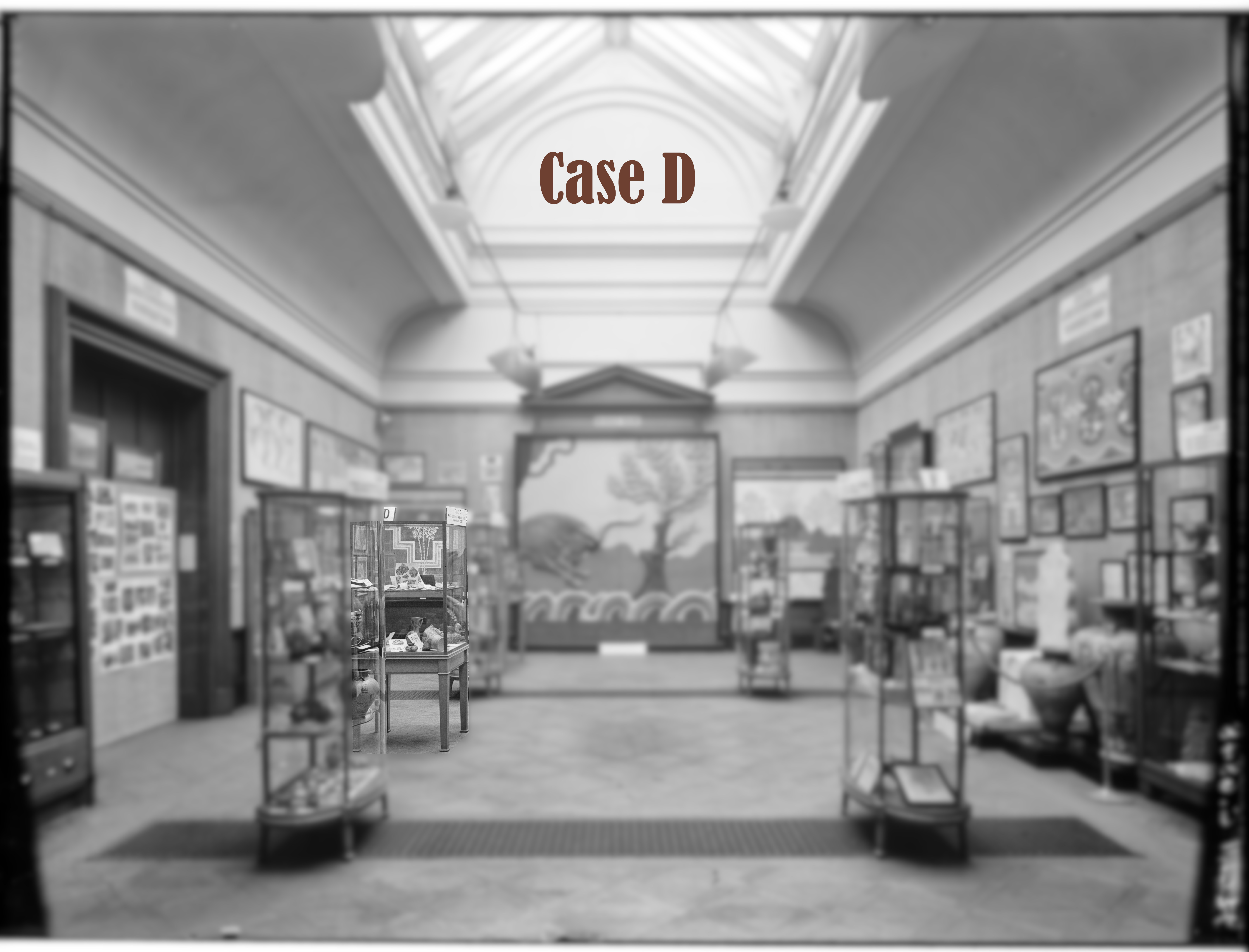
Standing Case D is visible in the photograph and contained objects related to the “Oriental” relations with Minoan Crete, namely artefacts concerning the Near East and Anatolia. The upper shelf contained a large collection of sherds from Ras Shamra (Ugarit) in Syria (excavated by Claude Schaeffer) and Tell Atchana, Turkey (excavated by Sir Leonard Woolley). For similar polychrome cups to those mentioned in the printed catalogue see this ‘egg-shell’ ware from Ras Shamra in the Louvre or the cup on the exhibition label: ‘Fragment of Bowl from Ras Shamra MM IIA’. The sherds from Tell Atchana were displayed on the upper shelf as well. Sherds with ‘double-axe trees’ were also present in the case. Although not visible in the case, the printed catalogue records a ‘Syro-Minoan’ marble head of a statuette which was found depicted in The Illustrated London News in 1936 (see below).
On the lower shelf sat a bull’s head rhyton (which now belongs in the Louvre collection) from Amisos (Eski-Samsun), Turkey with a ‘sacral ivy’ decoration around its neck. Several artefacts provided comparative ‘sacral ivy’ motifs, including the base of a jar, a sherd from Chirishli Tepe in Anatolia, and a Late Helladic alabastron from Egypt with the accompanying label ‘Alabastra from Egypt and Volo’. A missing exhibition label that resembled comparisons of Sacral Ivy Motifs (Evans, Arthur. 1935. The Palace of Minos at Knossos, IV. London: Macmillan.) in the Palace of Minos was next to the jar base. A duck-shaped and a goat-shaped libation vessel from Amisos are also visible in the photograph in the background of the case. These are probably two further objects from the Louvre, although both the duck and goat seem to have slight differences from the photograph. The exhibition labels ‘Lapis Lazuli Cylinder with Sumerian Types’ may have also been present in the case.
STANDING CASE D.-FINDS ILLUSTRATING ORIENTAL RELATIONS WITH MINOAN CRETE
Upper Shelf
PART OF A POLYCHROME CUP (a) of the finest ‘egg-shell’ ware from a tomb at Ras Shamra, in Syria, found by Monsieur Claude Schaeffer. As noted above (p. 8, cf. 16), it answers both in texture and in details of decoration to the remains of similar cups from the Royal Pottery Stores of Knossos, approximately dated by the Harageh deposit (Case C) to the reign of Senusert II (с. 1906–1888 B.C.).
Lent by the Louvre Museum.
SHERDS FROM TELL ATCHANA, (b) near the middle Orontes, illustrating Sir Leonard Woolley’s recent discovery of pottery of M. M. IIIa character, dating back to c. 1700 B.C. The ‘double-axe tree’ on some of these is especially to be noted, as a close parallel is to be found on a Cretan burial-urn. The ‘Double-Axe’ was the sacred symbol of the Minoan Religion.
Lent by Sir Leonard Woolley.
INLAID MARBLE HEAD OF A STATUETTE, from Major Myers’ Collection in the Eton College Museum. This head, formerly regarded as Egyptian, may with great probability be recognised as a work of the same Syro-Minoan School that produced a series of ‘Hathor-headed’ vessels in native faience. Its comparatively late date (probably 14th-13th century B.C.) is attested not only by its style, but by an iron tenon that seems to have attached the headpiece. The hair and eyelids are of inlaid lapis-lazuli: the eye is of similar inlay; the ear-rings are of red jasper.
Lent by the Provost and Fellows of Eton College
BULL’S-HEAD RHYTON (LIBATION VESSEL), from a tomb at Eski-Samsun (Amisos). It has reddish-brown decoration on white slip, belonging to a well-known class of Royal Hittite Pottery. Its ‘collar’ is decorated with the two-stemmed sacral ivy, taken from the L.M. Ib vase-decoration (c. 1500-1450 B.C.), here illustrated by the lower part of a painted jar from Palaikastro, Crete. Bull’s-head rhytons of this type had been erroneously classed with Hellenistic rhytons of the 3rd century B.C.
On the floor of Case D.
FRAGMENT OF A CONTEMPORARY VASE WITH SIMILAR IVY LEAF, from Chirishli Tepé in inner Anatolia, found 1904: from Professor Sayce’s Collection, now in the Ashmolean Museum.
DUCK-SHAPED AND GOAT-SHAPED VESSELS, from the same tomb at Amisos, further illustrate this Hittite class.
Standing Case E
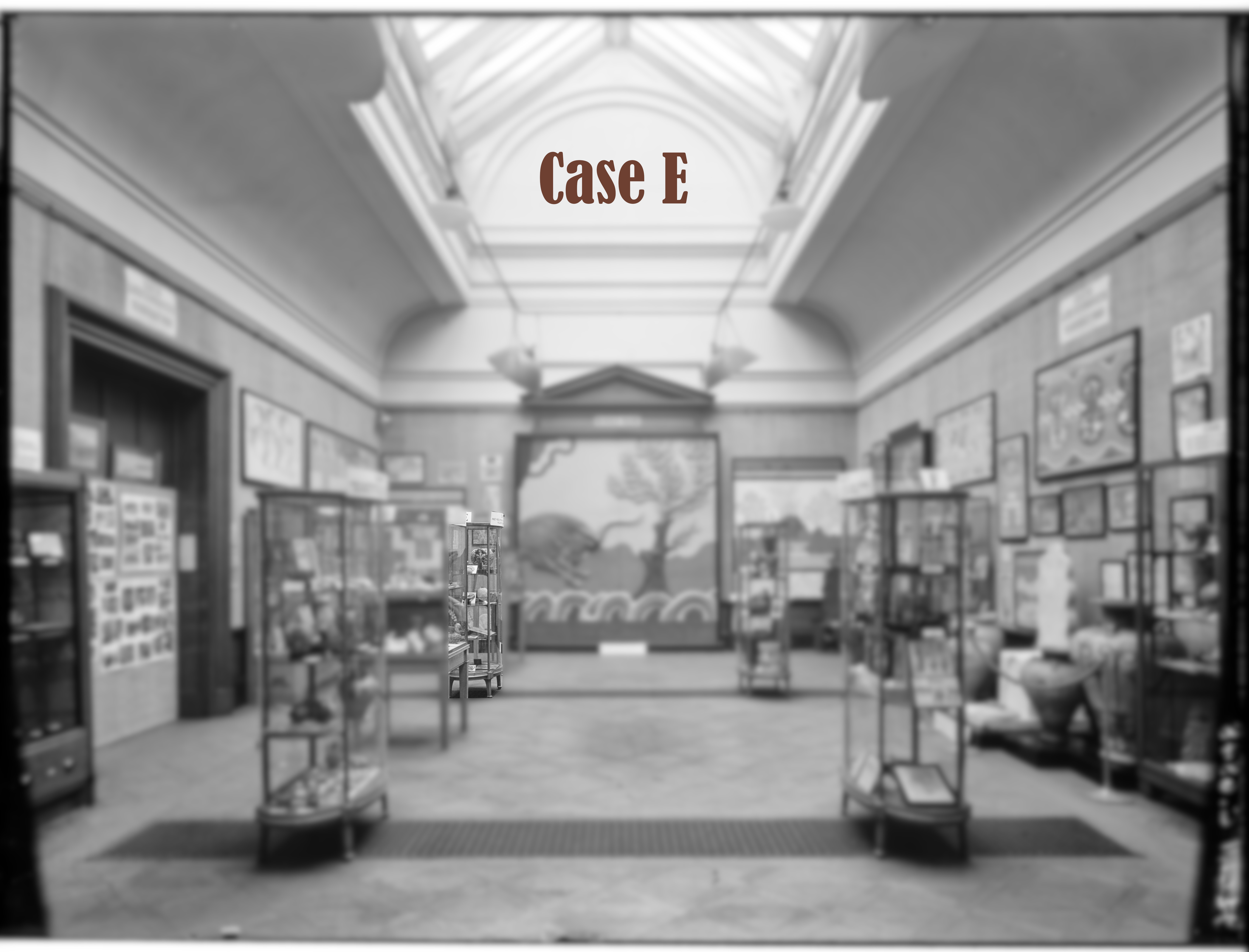
Standing Case E offered examples of fine ‘egg-shell’ ware
vessels from the Middle Minoan IIA period (1900 BCE–1850 BCE).
On the upper shelf, it is possible to see a replica
bridge-spouted vessel, similar in design to the ones in Case
C, but with floral decoration in white and orange. A few other
objects stood in front of the vessel, one of them possibly
being a fragment of a carinated bowl with white spots meant to
imitate Early Dynastic liparite bowls. In the photograph it is
also possible to see part of a polychrome bowl with
fleur-de-lis decoration (with accompanying label ‘Polychrome
Sherd of Egg-shell’ ware Knossos). While this vessel is
restored today, it was only a fragment at the time of the
Exhibition. Barely visible on the upper shelf behind the
bridge-spouted vessel is a polychrome bowl with white and
black veins, imitating stone breccia work. A polychrome
‘tazza’ or cup with thorn-like bosses and an ostrich-egg
rhyton sat on the second shelf from the top. The label of ‘MM
II Knossos Bridge-Spouted Jug with Thorn-Bossed Tazzas’ (see
below) is barely visible behind the cup. The labels ‘Modern
Ostrich Egg Flask and Minoan Rhyton Types Derived from
Egyptian Ostrich-Egg Flask’ were certainly present on the
shelf.
Although the printed catalogue does not mention the lower two
shelves, it is possible to make out two other labels:
‘Middle Minoan Polychrome Pottery from Below Olive Press
Room’
and ‘Polychrome Bowl’. It is
possible that
‘Kamares Cup with Handle’ is the
small, framed label whose reverse is visible in the
photograph. The case may have held these other exhibition
labels as well:
‘MM II Knobbed Pithos’,
‘Polychrome Cup with Flower Design’,
‘‘Egg-Shell’ Ware Kamares Cup’,
‘Kamares Cup with Spout’,
‘Kamares Bridge-spouted Vessel’,
and
‘Kamares Cup with Crocus Flowers’.
STANDING CASE E.-FINEST MIDDLE MINOAN IIA POTTERY, INCLUDING ’ EGGSHELL’ WARE.
Cf. Wall Case B, middle shelf, right.
Upper shelf.
BRIDGE-SPOUTED VESSEL, with elaborate decorated design, with fleur-de-lis: filler and jug showing stellate flowers (replica).
FINELY POLISHED CARINATED BOWL (fragment), copied from shape of Early Dynastic diorite examples (see Wall Case A); but in this case the white spots are imitative of a liparite original (see facsimile, Wall-Case A, middle shelf).
POLYCHROME TAZZA, with thorn-like bosses: development of barbotine’ work: it shows metallic lustre. Label
Middle shelves.
PART OF A POLYCHROME BOWL of extraordinarily thin fabric, with delicately embossed arcading, derived from fluting of bowls in precious metals: the arcading is surmounted by small fleur-de-lis. Label
BOWL of similar tenuous fabric; with polished red grooves on which are painted white stellate flowers like those of the vessels on the top shelf. The fine ‘egg-shell’-ware of this class is approximately dated by the example in Case C (Harageh find, p. 15), showing the ‘bat-and-ball’ motive, to the time of Senusert II (c. 1906–1888 B.C.).
POLYCHROME BOWL of similar thin ware: mottled brown ground with white borders and black veins, imitated from breccia.
On the floor of Case E.
PART OF A POLYCHROME VESSEL, showing olive-sprays and buds in white and red, facing olive flowers: supplying analogy to later fresco designs.
‘RHYTON’ IN SHAPE OF OSTRICH-EGG, a form of libation-vessel with white ground. Ostrich-egg vessels were clearly derived from the African side, where (as in the Sudan) such flasks are still common: an Egyptian imitation in marble occurs in a XI-XII Dynasty grave at Abydos. Tables show the later evolution of ostrich-egg ‘rhytons’.
Case K
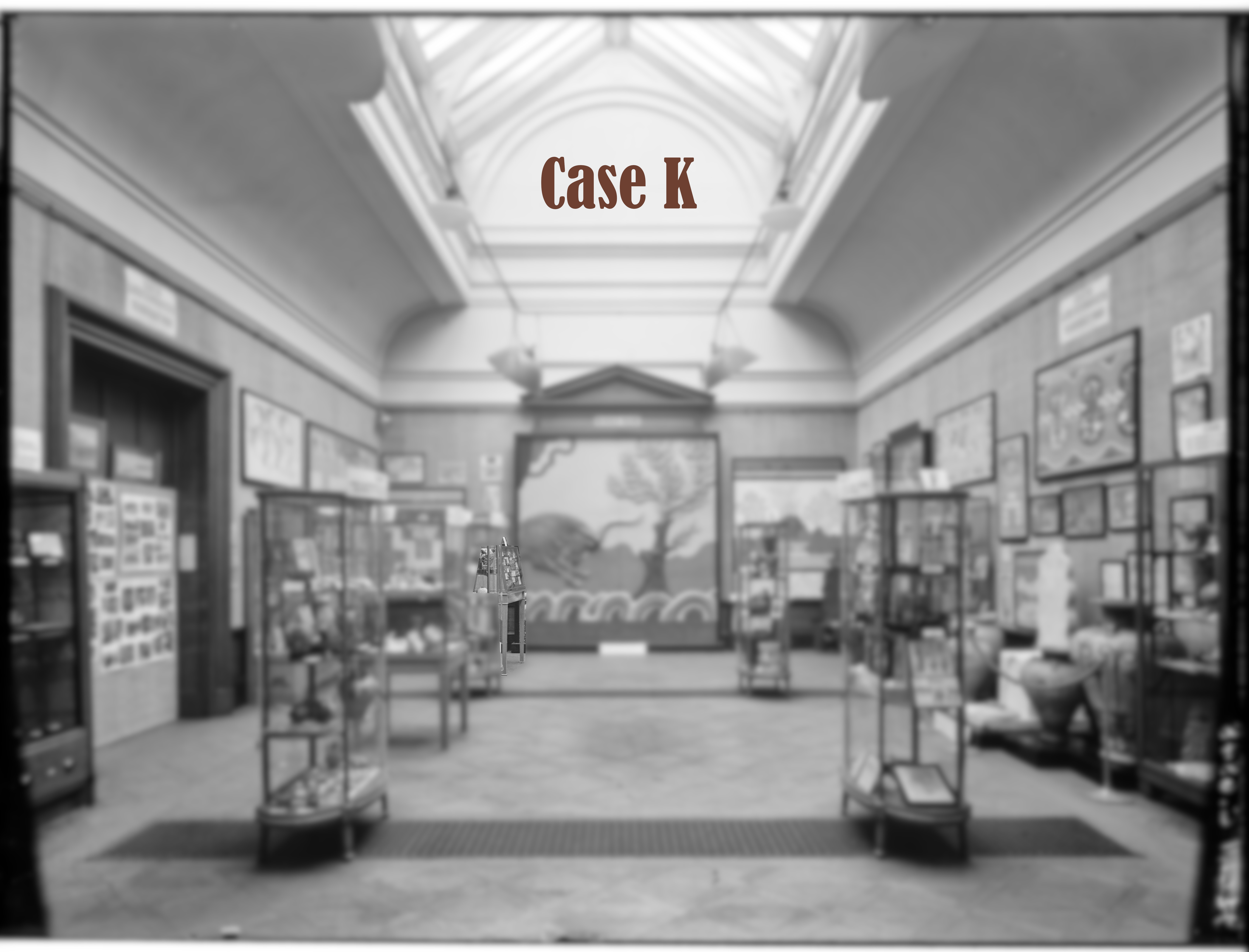
In the photograph of the Minoan Room, Case K is closest to the Charging Bull Fresco and displays sealstones and signet rings from Sir Arthur Evans’s personal collection. Unlike the other cases where it is possible to see distinct objects, all that can be seen in the photographs are the vague outlines of the sealstones. The signet rings were probably displayed on the opposite side. Therefore, the printed catalogue is the most reliable source for the contents of the case. Exhibition labels are seen in Case K. The following four exhibition labels were possibly in the case, but other labels seem to be missing or destroyed: ‘Egypto-Minoan Decorative Scrolls’, ‘Zakro Seal Impressions’, ‘Owl Vase as Ivory Seal’, and ‘Ivory Dove Seal’. Some of the signet rings which were not found in the Ashmolean’s collections may have only been illustrated.
The Ashmolean holds a large collection of sealstones and sometimes it is difficult to distinguish which seals were displayed when the descriptions are vague. The links in the printed catalogue text below are only given for certain seals. Possible choices are given in the following paragraph to allow one to imagine what could have been displayed.
CASE K (1).-MINOAN ENGRAVED SIGNET-RINGS AND BEAD-SEALS FROM SIR ARTHUR EVANS’ COLLECTION.
Left compartment of case as seen from the door.
ARCHAIC BEAD SEALS, in dark steatite, often three-sided, with rudely engraved designs, going back probably to early in the third millennium B.C.
These are succeeded by more compact and better executed specimens, some approximately dated by the double sickle’ motive, originating in Sixth Dynasty types of reversed lions (c. 2500 B.C.).
PERFORATED CAMEO OF TRIDACNA SHELL from Messara, in the form of a bearded head, which shows some affinities with proto-Egyptian types.
On the later series of these seals advanced pictography is seen, leading to the earlier Hieroglyphic Class A of the Cretan Script.
TWELFTH DYNASTY SCARAB from the Diktaean Cave, engraved with signs of this class.
LENTOID BEAD with a M.M. IIa ‘polychrome’ pattern: convoluted and other forms of seal.
SIGNET SEALS of the fully developed Hieroglyphic Class B.
MIDDLE MINOAN II SEALS. Case K (1): left compartment
PRISM-SEALS and ‘FACETTED CYLINDERS’ in crystalline stones with inscriptions of Hieroglyphic Class B, including the highly decorated red carnelian bead-seal of a prince whose emblem was the cat. The same hieroglyphic groups appear on a clay sealing with a portrait head.
A ‘Flat Cylinder’—a form that now makes its appearance-shows a galloping antelope in the same advanced M.M. II style.
This class of bead-seal is finely illustrated by a series of examples belonging to the earlier phase (a) of M.M. III (с. 1700-1600 B.C.), including the 'bull grappled at the tank,’ the ‘plumed tumblers,’ and the ‘fable of the goat and dog’ (see, too, p. 10 above).
A Calf’s head prepared for the table, on a remarkable lentoid, is of the same approximate date.
PART OF A CLAY SEAL-IMPRESSION, from Knossos, showing a lion pursuing a lioness; of the highest style of this art.
CLAY SEAL-IMPRESSIONS from the Harbour-town of Knossos, though in different clay, are identical with those from Zakro in Eastern Crete (see Case H).
Parrot-wrasse fish amidst its sea-pastures. Carnelian amygdaloid, boldly engraved; an early attempt at perspective.
Toilet scene, jasper lentoid, reflecting the M.M. III Palace friezes.
QUATREFOIL PATTERN, reproducing, in the round, a characteristic scarab-motive used for sealing Middle Kingdom documents in Egypt: of special interest since this M.M. signet type has been incorporated in the decorative design on Stela VI from the shaft graves at Mycenae.
TALISMANIC SEALS, a special section, mainly of the ‘almond-shaped’ (amygdaloid) form; with ships, fish, round huts with posts, water vessels of various kinds (rain-charms), lions’ masks, etc.
LATE MINOAN SEALS (c. 1550–1200 B.C.). Case K (1) : left wing.
LATE MINOAN Ia (from c. 1550 B.C.): FINE LENTOIDS with photographs and enlargements.
Wounded calf, endeavouring to extract an arrow; from Knossos district and (mottled carnelian) Mycenae: the motive recalls the fine contemporary " flat-cylinder’ gold bead from Mycenae with the wounded lion (replica for comparison).
Water-fowl in varied action (p. 16 above): greenstone from Mirabello.
Two recumbent oxen, one looking back, beside a tree: sardonyx amygdaloid, picturesque early style.
LATE MINOAN Ib (c. 1550–1450 B.C.): AMYGDALOIDS OF A NEW TYPE now appear, with grooves (sometimes lines) round the central truncated-oval boss of the back.
Hunter lassoing a Cretan wild goat: carnelian: a good early example.
ELONGATED SEALS are now cut from a well-known class of stone beads.
Hunter standing over the prostrate goat and giving it the coup-de-grace.
The ’ Minoan Genius’ in various aspects, a characteristic theme of the L.M. Ib style. One of these, leading a bull, is the earliest published Minoan gem.
Long-robed priest-princes are also a distinctive feature.
LATE MINOAN II (c. 1475–1400 B.C.), overlapping L.M. Ib: the latest Palatial class at Knossos, defined by hoards of clay impressions.
‘Antithetic’ schemes of opposed men and animal continue to be prominent, including the Lion Gate’ at Mycenae; an off-shoot of the Oriental Gilgames class, already well represented in L.M. Ib. A lentoid of special interest, with two opposed Griffins above an ox with a cereal sign (probably rye) between them: this seems to have been the seal of some official of the Granary Department.
The lentoid form is now almost exclusively in use, and the subjects–such as lions, bulls, and the acrobatic Minotaur types–are skilfully adapted to the circular field.
An intaglio with a coiled lion on a crystal seal-stone found with L.M. II sherds near Knossos, is of special excellence, as an example of the latest Palatial style.
SERIES OF LENTOIDS ILLUSTRATING THE BULL-GRAPPLING SPORTS, already in vogue in the preceding age.
The galloping bull caught in a net (hematite lentoid) is a novel subject on seal-stones, though anticipated by a clay impression from Hagia Triada.
The bull nosing the decoy cow also appears; and a complete circus scene.
A clay seal-impression, from the Palace, with inscriptions on two sides shows the ‘Minoan Herakles’ lifting a large bull.
Cattle-pieces of a more general kind are now common.
Derivatives of the Nilotic duck-hunting scenes are also frequent.
CONVOLUTED SEAL DESIGNS continue in a more decadent aspect through the succeeding phase.
Two black steatite seals,2 recently found in the Candia district, belong to a hitherto unrepresented glyptic style parallel with the ‘Late Revival’ in Ceramic art of the close of L.M. IIIb (c. 1300 B.C.). The Argonaut, conventionalised, is clearly shown on one of them, with its tentacles, a favourite motive of this style.
The engraving of seal-stones has now apparently ceased on the mainland side. But it continued in Crete, even on crystalline rocks, to the latest ’ Sub-Minoan times: L.M. IIc 1 (c. 1200 B.C.).
Right compartment.
CASE K (4).–GOLD SIGNET-RINGS AND BEAD-SEALS.
With these is grouped an agate signet-ring from a chamber tomb at Lyktos, showing a chieftain driving a chariot of the later Palatial type, drawn by wild goats, like the God Thor. (Case K 3.)
A. THE ‘RING OF NESTOR’: Gold signet-ring from the larger beehive tomb at Pylos (Kakovatos: see p. 11) It supplied the first picture of a Minoan Afterworld: see restoration in ‘Miniature Fresco’ style. (Case F bottom.)
B. THE ‘RING OF MINOS’ (see p. 11): replica executed from the original which has now disappeared. Its finding by a peasant lad led to the discovery of the Temple Tomb at Knossos (p. 11). The design consists, like that of the ‘Ring of Nestor,’ of three separate scenes, illustrating the departure of the Goddess from a rock-set pillar-shrine with sacred tree; the crossing of an arm of the sea in her bark; and her arrival at a similar shrine, where a youthful minister offers her refection from the juice of another sacred tree.
C. THE ‘THISBÊ TREASURE’ (pp. 10, 11). This unique illustration of L.M. Ia and b intaglio style, on gold signet-rings and beads, brought to light in a chamber-tomb at Thisbê on the Boetian coast, (as it now appears) about 1910, has never before been publicly exhibited.
The intaglio scenes, clearly answering to known episodes of Greek tradition, such as the slaughter of Aegisthos and Clytemnestra by Orestes, and of the Sphinx by Oedipus, were so surprising that many doubts inevitably arose as to their genuineness. At the same time, the presence here of ‘heroic’ pieces quite agrees with the designs of combat On the ‘signets’ from the Shaft Graves at Mycenae, which (as Schliemann first pointed out) clearly represent episodes of ancient epic, some at least recorded in Homer. They form themselves a collective whole not only in the general fabric, which is purely Minoan, but in the character of the designs, which seem to be mostly from the hands of the same engraver, and by curious evidence of having been, one and all, subjected to the same pressure on their back, due to some disturbance of the tomb, which had thrown the jewels on their faces. This is well shown by the electrotypes presenting the backs of the objects, placed beside the series presenting the intaglios. They were associated (to my knowledge, A.E.) with other gold jewels going back in date to at least c. 1500 B.C., including a miniature pyxis or round box resembling those from the Third Shaft Grave at Mycenae. To myself such critical instincts as had been personally acquired through a lifetime devoted to such minute studies were quite decisive as to their genuineness; and they were shared by the late Mr. R. B. Seager, who for years had collected Minoan seal-stones, and whose flair and knowledge as regards Minoan antiquities as a whole are generally recognised. But in addition to this, a series of crucial points connected with the Thisbê jewels have since received illustration of such a kind as to place the execution of the intaglios outside the capacity of the most skilful forger.
A good illustration of this is presented by the theme of No. l of the group, where a female figure fills a jar from an ewer beside a tree: to be taken, probably, as a rain-charm, of a class represented by a series of simpler designs of ewers and foliage on a talismanic class, of the immediately preceding epoch. The figure pouring into the jarwas entirely new, however, and therefore, in the eyes of those who condemned the Treasure, an invention of a forger. Some years afterwards, however, among remains of seal-impressions derived from the ‘Room of the Archives’ at Knossos, a version of this same scene came to light: see Drawing in Case K.3
Three of the bead-seals, though clearly from the same sepulchral vault, belonged to the ‘flat cylinder’ type, which as an intaglio form practically dies out in the Late Minoan Ia period. The style of engraving, too, in these cases — Overthrow of man in bull-grappling scene; Matador; Lion seizing Bull—is also finer and somewhat earlier in its affinities. That there are also bead-seals belonging to this group, of the same amygdaloid form as those belonging to the better represented parure, but without the engraved lines on the back (the distinctive mark of L.M. Ib) that all these bear, is here demonstrated for the first time.
A Pig-sticking Scene, No. 6 of the later group, has the shaft of the hunter’s spear ring round at intervals: this feature which points to a composite shaft, made (like those of the lictors’ fasces) out of several rods or canes, reappears in the case of spearmen both on a signet ring from the Fourth Shaft Grave at Mycenae, and on a gold bead obtained by the late Professor Bosanquet in 1910 from a Boeotian peasant, subsequently acquired by Dr. Hogarth for the Ashmolean Museum, and on other grounds comparable with the Thisbê series. A recent examination of the underside of this shows that pressure marks identical with those on the Thisbê beads are visible. Electrotypes presenting both back and front of this are set beside the others in Case K. Both the finer character of the engraving, and the absence of the lines on the back, places this with the L.M. Ia element of the Thisbê Treasure. Incidentally, it may be observed that two Directors of the British School—the latter of special expertise as to seal-stones—have both supplied a valuable warrant for its authenticity.
D. SIGNET RINGS ILLUSTRATING MINOAN WORSHIP AND SPORT.
A GODDESS SITS BENEATH A VINE and is tended by adorant women: replica of original in the Athens Museum; found by Schliemann at Mycenae in excavation outside the Shaft Grave area.
GENII BEARING LIBATIONS TO THE GODDESS: enlarged photograph of a signet ring from the ‘Tiryns Treasure’.
HELMETED PERSONAGES, HOLDING REEDS, IN ACT OF ADORATION BEFORE THE GODDESS, who sits with the child-God in her lap. Offerings, in the shape of a tripod and vases, are seen behind the adorants: a curious anticipation of the ’ Adoration’: see p. 11. A Christian ring design of c. 500 A.D. is exhibited for comparison.
SIGNET RINGS ILLUSTRATING BULL-SPORTS; one from a chamber tomb at Arkhanes, a Minoan centre inland from Knossos; showing an acrobatic feat; another, with a fallen performer.4
SIGNET RING: THE GODDESS AND HER SACRED TREE ABOVE A DEPARTING VESSEL: from near Candia, perhaps from the harbour town of Knossos.
SIGNET RING: YOUTHFUL GOD DESCENDING BEFORE HIS OBELISK in front of a walled enclosure with Sacred Trees; in front is a female adorant. Among religious subjects supplied by this group, this is perhaps the best illustration of the baetylic form of worship, in which the divinity is regarded as temporarily infusing itself into a material object. From the site of Knossos, acquired by A. E. in 1904.
SIGNET RING: A FEMALE ADORANT IN THE ACT OF ADORATION before a baetylic shrine on a rock, with a Sacred Tree behind.
SIGNET RING: TWO LIONS TETHERED TO A COLUMN: a variant of the ‘Lion Gate’ composition (see East Room, Mycenae 119): From Mycenae, obtained by A. E. in Athens, c. 1893.
E. OTHER SIGNET RINGS ILLUSTRATING ABIDING TRADITIONS OF EPIC EPISODES.—Three ivory signets, with bezels and contemporary swivel-hoops, found in a tomb near the site of Kydonia in Western Crete, dating from c. 300 B.C. [1], [2], [3]
WARRIOR STABBING A LION WITH A SHORT SWORD: a copy, translated in a Hellenistic manner but otherwise sufficiently exact, of the well-known type, on a gold ‘flattened cylinder,’ from the Third Shaft Grave at Mycenae.
A WARRIOR WITH A ‘FIGURE-OF-8’ SHIELD slung on his back in Minoan fashion seems to aim part of a curved object at a figure sitting against what looks like a bent shield; a misunderstood copy of the sardonyx amygdaloid bead-seal (perhaps representing Periphetes tripping backwards over his shield) from the same Third Shaft Grave at Mycenae, curiously travestied by Schliemann’s artist.
The Hellenistic workmanship of this group of ivory signet rings is undoubted, and implies knowledge of Minoan originals other than those of the then inaccessible Third Shaft Grave. This find is one of the strangest in the whole history of archaeological discovery.
Standing Case F
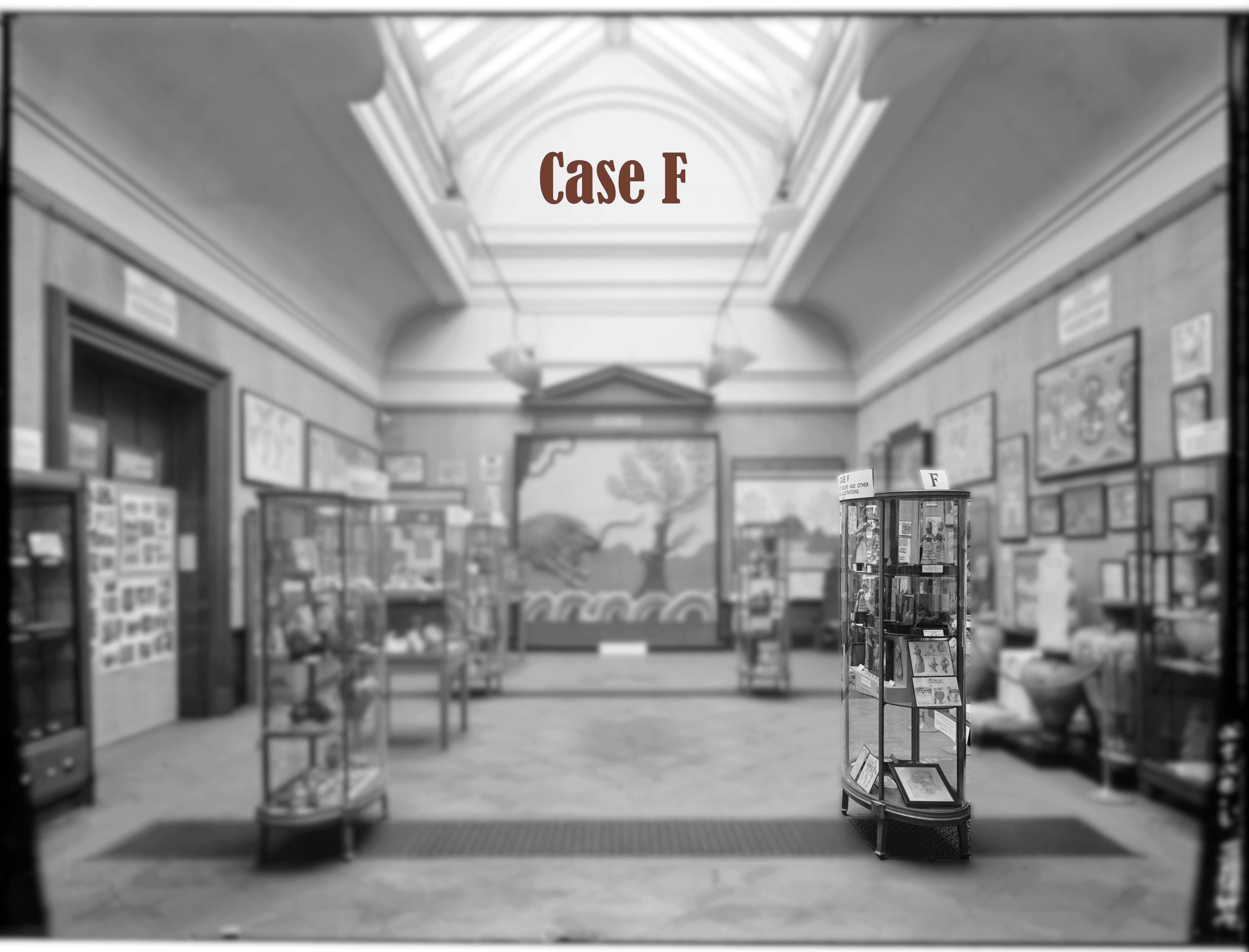
Standing Case F, which is visible in the foreground of the right-hand portion of the Exhibition photograph, was dedicated to Religious Figurines and Reliefs. The upper shelves contained two Snake Goddess figurines (Goddess in Corset and Flounced Robe and Goddess or Votary) from the Temple Repositories (c. 1600 BCE), two stone-lined cists filled with luxury artefacts that Evans considered to have come from a shrine. On the same shelf was a figurine of a goddess lent by the Fitzwilliam Museum in Cambridge.5 The second shelf from the top held a number of figurines. The Chryselephantine Figure of a Snake-Goddess was a replica made by the Director of the Boston Museum for Evans’s Minoan Room. Next to this figure is the outline of a Boy-God offering up his ‘childhood’s lock’, illustrated in this BSA archival photo. Another ivory figure of a Boy-God was present in the case along with an exhibition label of Boy God Adoring Goddess (linked below). On the same shelf, but not visible in the photograph, were two bronze replica statues of male figures, one a Boy-God with a peaked tiara and the other a votary. According to the printed catalogue, an exhibition label illustrated ‘Our Lady of Sports’, a figurine from the Royal Ontario Museum, Toronto. On the third shelf from the top, it is possible to see several other Temple Repository replicas: votive robes, girdles, a plaque of flying fish, cockles and argonaut-shells, and a marble cross. Relief plaques of a goat and its young and a cow and its calf, and a ritual vessel with rose-leaves were also likely in the case according to the printed catalogue. On the same shelf, the exhibition labels ‘Adder Mark of Minoan Goddess’ and ‘Bronze Figure of Goddess with Snakes’ (see below) displayed additional religious symbolism and are visible in the photograph. The exhibition labels ‘Clay Utensils from the Snake Room Knossos’, ‘Section of Terracotta Water Pipe’, ‘Bethshan Pottery Stand’, ‘Snake Tube’, and ‘Tripod Snake Table’ were likely on the same shelf as the above exhibition labels. Somewhere in the case the label 'Clay Pillar Model with ‘Birds’ (see below) was also displayed as it fits with the printed catalogue entry describing doves on terracotta pillars.
On the lowest shelf, ‘Bronze Locks from Wooden Statue’ and an Inlaid Gaming Board label are visible in the foreground. Two illustrations from the Palace of Minos are visible on this shelf as well, but they are missing as exhibition labels: Youth with Bronze Curls (Evans, Arthur. 1930. The Palace of Minos at Knossos, III. London: Macmillan.) and Crystal Plaque with Bull (Evans, Arthur. 1930. The Palace of Minos at Knossos, III. London: Macmillan.). The following exhibition labels may also have been displayed in the case, or at the very least considered for placement in the case during exhibition installation: ‘Ivory Figurine of a Boy God’, ‘Great Stone Cists of Temple Repositories’, ‘Gold Foil from Temple Repositories’, ‘Excavation of Temple Repositories’/‘Temple Repositories as Opened Out’, ‘Goddess or Votive and Snake Tubes Gournia’, ‘Arrow Plume of Bone’, ‘Common Viper or Adder’, ‘Bronze Figurines from Beirut and North Syria’,‘Female Statuette of Bronze’, ‘Votive Monument with Plaited Locks’, and ‘Upper Part of Bronze Minoan Figure of Snake Goddess’.
STANDING CASE F.-RELIGIOUS FIGURINES AND RELIEFS.
Top shelf.
FAIENCE GROUP FROM FITTINGS OF SHRINE FOUND IN THE TEMPLE REPOSITORIES, KNOSSOS: facsimiles by the Danish artist, Halvar Bagge.
a. GODDESS IN CORSET AND FLOUNCED ROBE, round whom three snakes (symbols of her chthonic power) coil upwards to her tiara.
She holds out the heads of two; that of the third rises uraeus-like above the tiara.
b. GODDESS OR VOTARY: similar figure, with feline animal on her head, holding out two snakes.
c. Votive Robes [1], [2] and Girdles [1], [2].
d. Ritual Reliefs; goat and young; cow and calf.
e. Ritual Vessels; chalice with spray of rose-leaves; another with fern-fronds (in Case H).
f. Flying-fish, cockles, and argonaut-shells, grouped within rock border (in Case H).
g. Marble Cross, perhaps for intarsia work
FIGURE OF A GODDESS, in mottled marble, similarly attired, but without snake: in two pieces, joined at the waist by a tenon. Lent by the Fitzwilliam Museum. Label
CHRYSELEPHANTINE FIGURE OF A SNAKE-GODDESS: facsimile made under the superintendence of Mr. L. D. Caskey, Director of the Boston Museum.
IVORY FIGURE OF A BOY-GOD, with holes for attachment of thin gold plate for loin-clothing and the borders of his tiara. On tiptoe as he stands with his high headpiece, the figure is practically the same height as the Boston Goddess, and both probably belong to the same height as the Boston Goddess, and both probably belong to the same group (see illustration), the Divine Child saluting the Mother Goddess. A. E. Collection. Label.6
IVORY FIGURE OF AN OLDER BOY-GOD, tonsured to offer up his ‘childhood’s lock’: he probably wore a biretta of thin gold plate such as was found attached to his loins. A. E. Collection.
BRONZE FIGURE OF A BOY-GOD, with peaked tiara, from the Harbour Town of Knossos: cast. Original in the Candia Museum.
BRONZE FIGURE OF A MALE VOTARY: one hand in attitude of adoration: from Crete: cast. Original in Athens Museum.
Middle Shelves
CHRYSELEPHANTINE FIGURE OF ‘OUR LADY OF SPORTS’, showing a Minoan Goddess in gold-plated corset and male loin-clothing, also worn by female taureadors: coloured illustration. Original in Royal Ontario Museum, Toronto. Label
THE DOVE AS MEDIUM OF DIVINE POSSESSION, settled on pillars of a terracotta shrine, Knossos (M.M. IIb); of posts of a terracotta swing, with votary (or Goddess) in sacral act of swinging (see, too, p. 19); on handles of a gold chalice-the ‘Cup of Nestor’ from the Fourth Shaft Grave, Mycenae (L.M. I) and on the head of the Goddess herself. Label
IVORY FIGURINE OF A LEAPING YOUTH (cast), from a model of sacral bull-sports. From Ivory Deposit, Knossos.
BRONZE GROUP OF YOUTHFUL ACROBAT ON GALLOPING BULL Lent by Captain E.G. Spencer-Churchill
TRANSLATION INTO MINIATURE FRESCO STYLE OF THE DESIGN ON THE ‘RING OF NESTOR (Evans, Arthur. 1930. The Palace of Minos at Knossos, III. London: Macmillan.), relating to Death, After-Life, and the Minoan Underworld: Goddess with female companion; butterflies and their hooked chrysalises above, emblems of resurgence; young couple, joined in death; "Tree of the World,’ with sacral ivy, dividing the scenes; Lion Guardian of the Underworld, tended by twin handmaidens (Diaskourai) of the Goddess; profane entrant warned off by She-Grin; young couple guided by She-Griffins to Winged-Griffin (Inquisitor) on Judgment-Seat; Goddess behind. At foot of tree, dog-like Monster, prototype of Cerberus. See Case K, for this Signet Ring.
ILLUSTRATIONS OF DOMESTIC CULT IN THE ‘SNAKE ROOM’ AT KNOSSOS, and its bearing on the Cult of the Snake-Goddess: —
a. Evolution of ‘Snake-Tube’ of Minoan Shrines from a section of terracotta water-main (illustrated). Label
b. Knotted snakes seen on figurines of the Goddess of natural suggestion (self-knotted blind-worm). Label
c. ‘Snake Table’ and various other utensils of the Snake Room (illustrated). Label
d. Survival of this cult object in Cyprus and at Bethshan. Label
INLAID GAMING BOARD, from Domestic Quarters of the Palace, Knossos: copy in colours.
On floor of Case.
Standing Case G
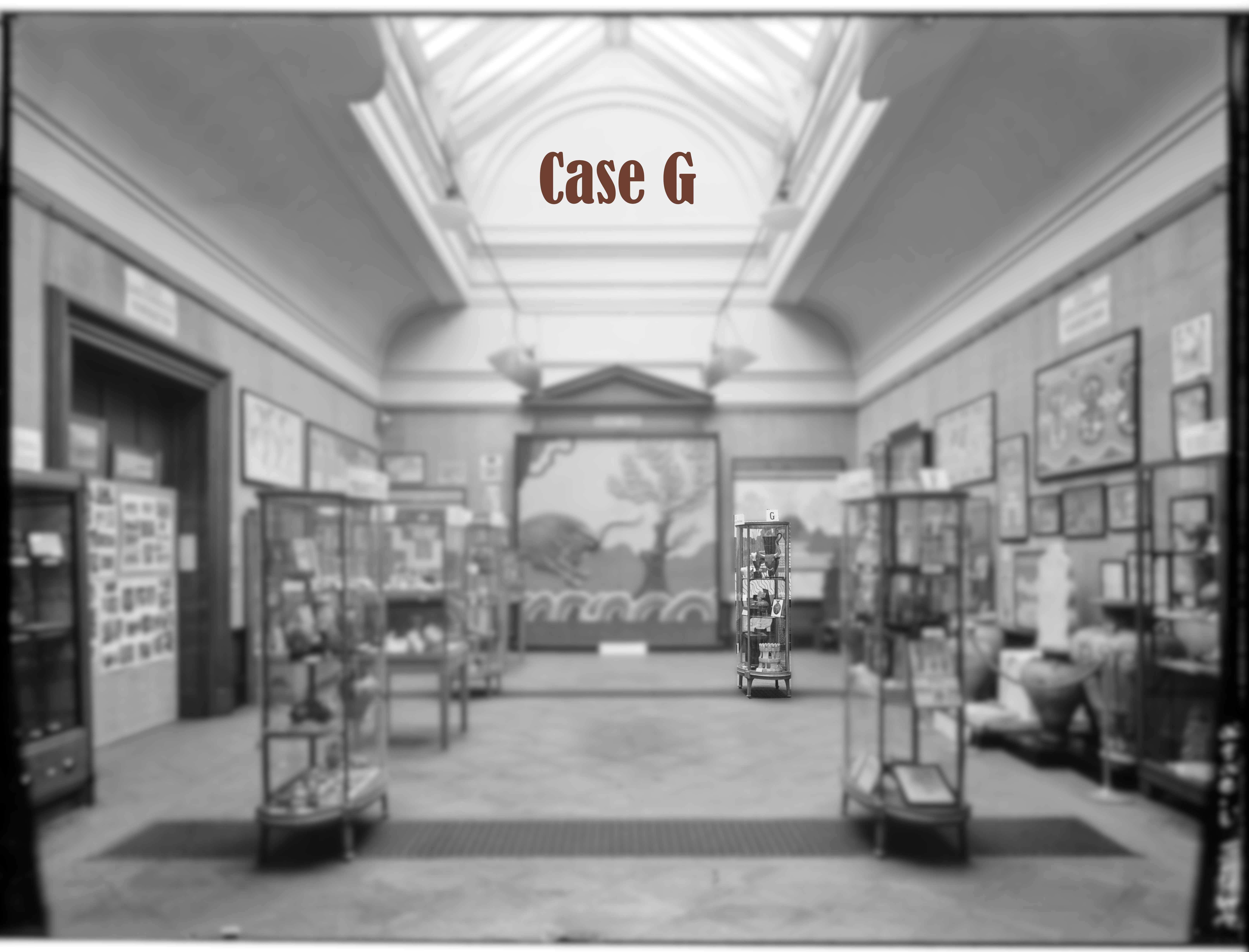
Standing Case G is visible in the background behind Standing Case F. It contained ritual vessels or equipment from the Middle and Late Minoan periods. A collection of replicas stood on the upper shelf (visible in the photograph): the bull’s head rhyton from the Little Palace, three stone lion’s head rhyta (one replica, one original, and one replica forepart from Delphi), the Chieftain Cup, and the tall conical rhyton (or Boxer Rhyton). The electrotype of the gold lion’s head rhyton from Mycenae is just visible on the upper shelf.
On the second shelf it is possible to see the electrotype replicas of the Vapheio cups from Sparta and the Harvester Vase with a corresponding label. The votive plaque from the Diktaean Cave, the goddess swinging between two posts, and the fragment of steatite rhyton illustrating a walled enclosure (see below) were either on the second or third shelf but are not visible in the photograph. The large exhibition label behind the Harvester Vase may be the exhibition label Silver Rhyton from Fourth Shaft Grave Mycenae and displayed the fragment of the Siege Rhyton in front of it.
On the lowest shelf it is also possible to see the replica of the Diktaean Cave libation table, the outline of a double axe, and a clay ‘Model of a Circular Building’ with painted horn motifs. This case seems smaller than the others in the Exhibition, but it possibly also contained the following exhibition labels: ‘Gold Cups from Vapheio’/‘Gold Vases Vapheio’, ‘Bronze Cup of Vapheio Type from Mochlos’, ‘Silver Cup from Vapheio and Clay Cup from Saxony’, ‘Details of Bull’s Head Rhyton from Mycenae and Knossos’, ‘Section of Bull’s Head Rhyton’, ‘Sections of Lioness Head Rhyton’, ‘Ritual Stone Vessels from Treasury of Sanctuary Hall’, and ‘Alabastron from Fifth Shaft Grave’.
STANDING CASE G. - RITUAL VESSELS AND ILLUSTRATIONS, WITH SMALL RELIEFS.
Top Shelf.
‘RHYTON,’ IN SHAPE OF BULL’S HEAD (horns and one side restored), for libations; from shrine to south-west of Little Palace, Knossos: of dark steatite, with shell inlay, and crystal eye, painted beneath: early Late Minoan.
RHYTONS, IN SHAPE OF LIONESSES’ HEADS, in white marble-like material; one original, restored, the other a replica: from Treasury of Central Sanctuary of Palace, nose of one example: ‘Late Palatial,’ L.M. II (с. 1450-1400 B.C.).
FORE PART OF A LION-HEAD ‘RHYTON,’ of similar marble, from beneath the inner sanctuary (adyton) at Delphi; found by the French Mission. In the same deposit occurred miniature Double-Axes, as used in Minoan cult. Singular evidence of existence of the pre-Hellenic cult of the Knossian Goddess at Delphi (cf. p. 9).
ELECTROTYPES OF SIMILAR LION HEADS IN GOLD from Schliemann’s excavations at Mycenae.
GOLD CUPS FROM THE VAPHEIO TOMB near Sparta (facsimiles): They illustrate (a) hunting of half-wild Urus bulls accompanied by cowboy feats; (b) decoying of the same by means of a cow, followed by successful lassoings. Found with L.M. Ib pottery (c. 1500 B.C.), but perhaps themselves of earlier fabric. The ‘Vapheio’ type of cup goes back in Crete to M.M. III: see comparative illustration. Scene (a) was clearly anticipated by the reliefs of the North-West Portico at Knossos, of which a portion is reproduced on the End Wall: it is possible that Scene (b) was similarly anticipated in the reliefs of the opposite East Portico. Originals in Athens Museum.
BRONZE VOTIVE PLAQUE with doves, sacral horns, and trees; and apparently the dedicator’s name, from the same votive stratum of the Dictaean Cave as the Libation Table.
Middle Shelves.
GODDESS OR VOTARY SWINGING BETWEEN TWO POSTS, on which are perched doves, significant of divine possession: from Hagia Triada; replica; for sacred swing, see Palace of Minos IV, 24-26. Also illustrations of similar perched doves from terracotta Shrine, Knossos (illustration: for replica, see Case F).
Middle Shelves.
‘HARVESTER VASE’ ‘RHYTON’: of ‘egg-shell’ form, from Hagia Triada, restored replica. It shows a ‘revel rout’ of countrymen with forks, with long-haired leader wearing a kind of ritual corslet. Label
‘CHIEFTAIN VASE’ of black steatite, from Hagia Triada: replica: Youthful Prince and attendant who holds a holy-water sprinkler and a sword, symbols of divine and terrestial dominion, seen also in the hands of the Goddess. M.M. IIIb.
TALL CONICAL ‘RHYTON’ of black steatite, from Hagia Triada: restored replica; once overlaid with gold leaf; scenes of bull-hunting and boxing. M.М. IIIb.
PART OF A VESSEL of black steatite from site of Knossos, 1904 (A. E.), with relief showing altar with sacral horns; part of two male figures, and walled enclosure with olive trees.
PART OF SILVER CONICAL RHYTON from Mycenae, showing a siege scene: replica and illustrations of vessel as restored. Original in Athens Museum.
Bottom Shelf.
LIBATION TABLE of black steatite, with inscribed dedication in the Linear Script A: from votive deposit (M.M. IIIb) of the Dictaean Cave; part obtained on the spot in 1895 by A. E.; restored with conical baetylic pillars below. A cast of an additional inscribed fragment found by M. de Margne, of the French Mission, is also shown. With this are exhibited votive bronze Double Axes, from the same ritual stratum (one on stepped stone base) and bronze figurines.
TERRACOTTA MODEL OF A CIRCULAR BUILDING, the religious character of which is shown by its ‘Horns of Consecration above. The windows give remarkable early illustrations of the Romanesque’mid-wall shaft’; from Gourniá, Crete: Late Palatial, L.M. II (c. 1450–1400 B.C.)
End Wall with Charging Bull
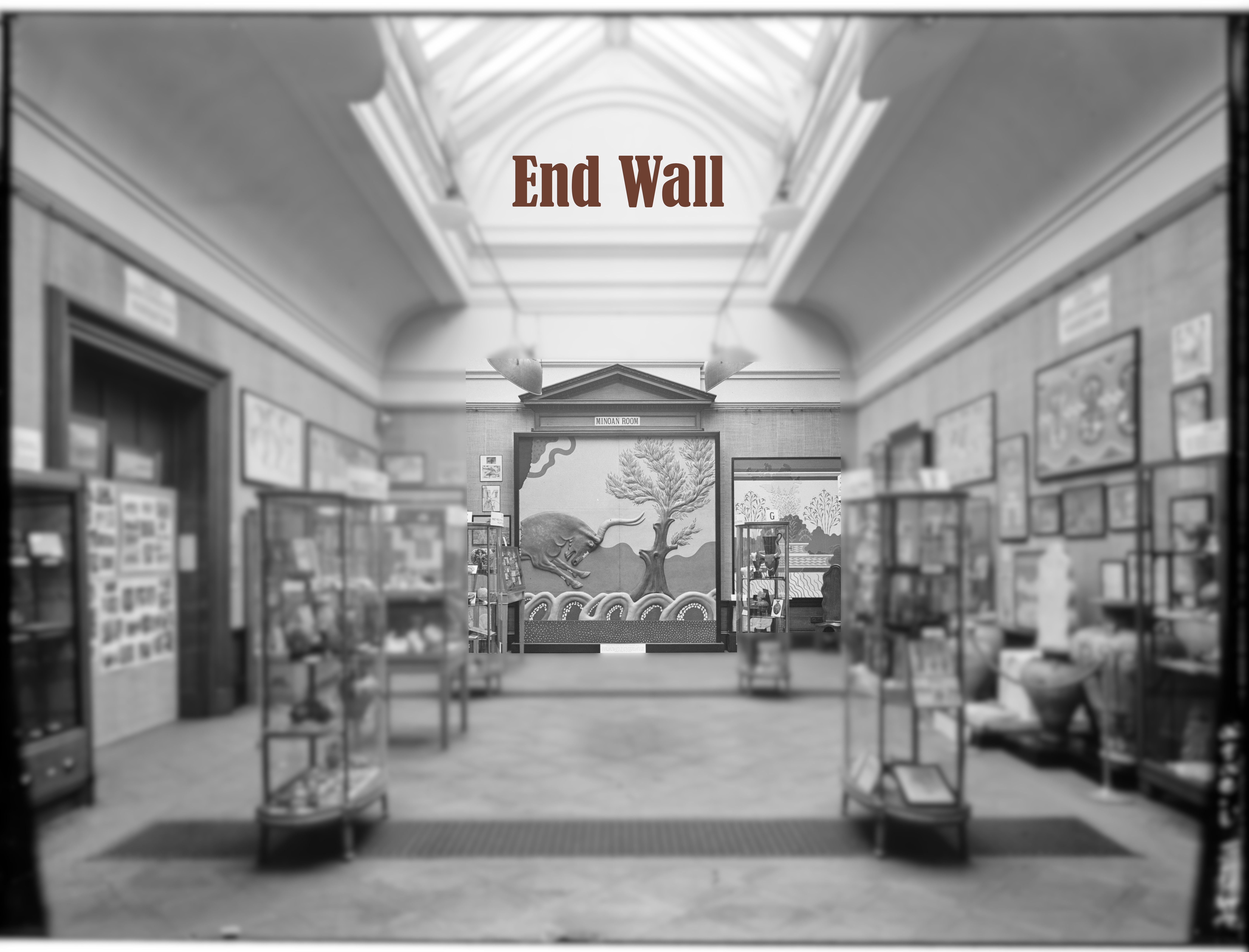
A plaster cast of a Charging Bull Relief dominates the End Wall, or the Wall furthest in the photograph. This cast does not survive but was originally composed of four to five parts made specially for this exhibition. Immediately to the left of this relief was a series of four framed illustrations. The top one, completely visible in the photograph, was a copy of the Dolphin Fresco from the Queen’s Megaron. Below it hung a (missing/misplaced) exhibition label which depicted Piet de Jong’s drawing of the North Entrance Passage of the Palace of Knossos and a coloured drawing of the Western Portico (see below), where the Charging Bull would have been displayed. Along the floor close to the Charging Bull relief were two casts of gypsum reliefs (from originals in the British Museum) from the Tomb of Atreus at Mycenae. These depicted bull scenes that Evans thought were comparable to the central Charging Bull, and argued that they were all of a similar date. On both the left and right of the central relief were two large reconstructions of wall paintings from Amnisos, an ancient beachside villa near Knossos excavated by Spyridon Marinatos. The two images above the Amnisos fresco on the left are discussed in the above section ‘Wall above Case B’.
Wall near Case H
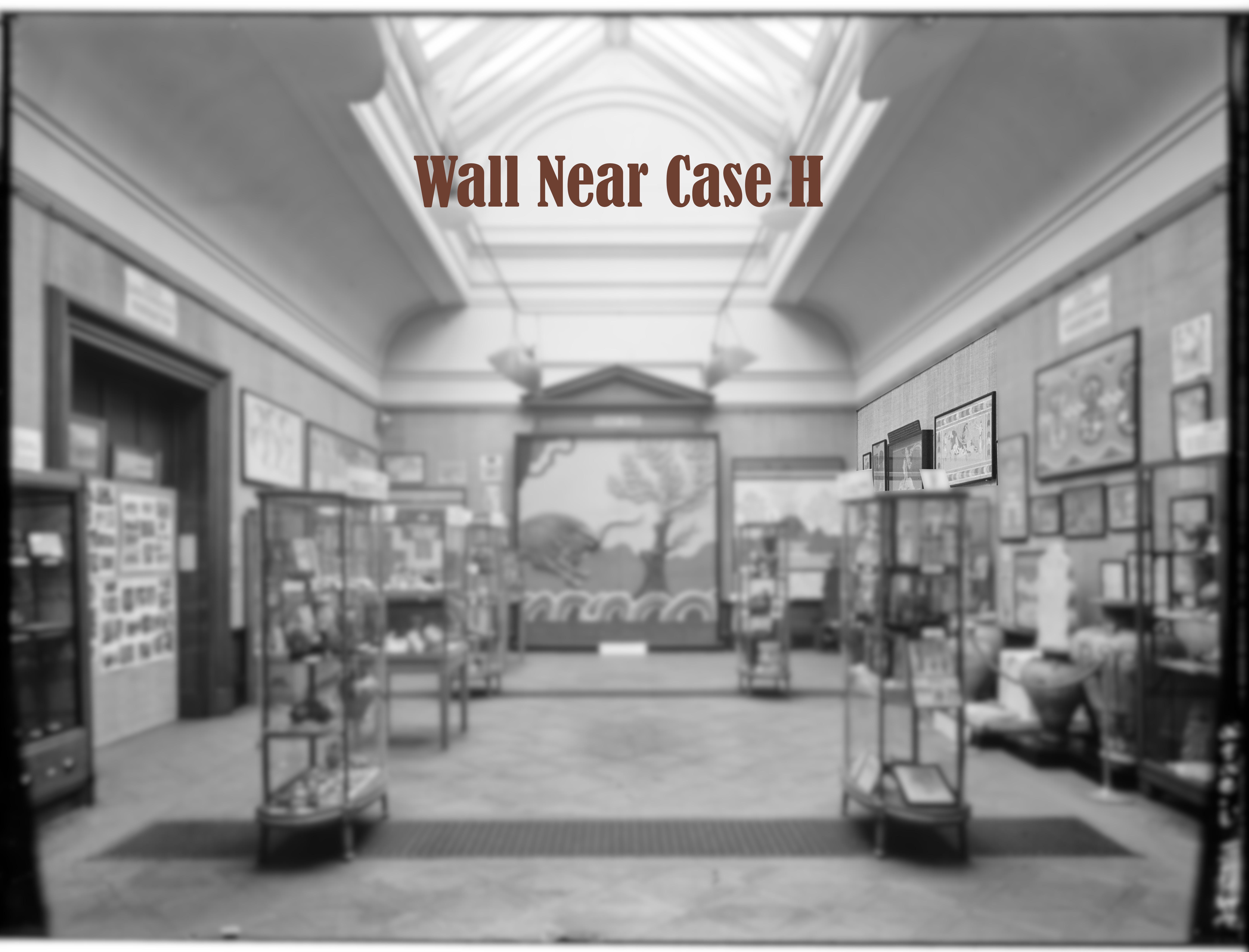
On the wall nearest Wall Case H (directly blocked by Case F in the photograph), it is possible to see the painted stucco bas-relief of the Priest King, the Cup-Bearer Fresco, and possibly a figure from the Procession Fresco. It is possible that the replica plaster reliefs of various parts of the body were displayed beneath these framed other images. Above the case was a reconstruction of the Taureador Fresco, showing three figures involved in bull-leaping. The rest of the exhibition labels on the wall are covered in another section below.
PAINTED STUCCO RELIEF OF CHARGING BULL. End Wall, centre.
Olive tree in low relief, to right; rocks below conventionally shown as seen in section, largely completed: of the main relief the bull’s horns and parts of the forelegs and body are restored; from the Western Portico of the North Entrance Passage of the Palace: see
COLOURED DRAWING OF THE WESTERN PORTICO , to left of the relief.
This work, illustrating the sensational quality of Minoan art, together with a singular mastery of natural forms, formed part of a great composition in the Western Portico. There were some traces of a companion piece in the opposite Eastern Portico; and the best clue to both seems to be provided by the scenes, on the somewhat later gold cups from the Vapheio Tomb (see Standing Case G, opposite); on the one, of bull-catching; on the other, of capture by means of a decoy cow. It looks as if the monumental reliefs of the Great Palace had had a wide influence on Minoan art. At Mycenae this is particularly visible in the reliefs (executed, not in stucco but in Cretan gypsum) brought by Lord Elgin from outside the façade of the ‘Atreus Tomb,’ from similar compositions, in which a stationary bull also takes part, showing that both scenes were given (p. 24).
See casts on floor to left.
In the case of the charging bull, here partially shown, a similar olive tree appears.
These more or less contemporary works, probably from the hands of a Knossian artist, are of considerable interest, in their bearing on the date of the ‘bee-hive tomb’ itself, the dromos of which contained remains of a stone jar, with inlaid ornament (see Wall Case H, middle shelf), a M.M. IIIa tradition.
To left of the Great Painted Relief.
REPLICAS OF PAINTED PLASTER HIGH RELIEFS: showing various parts of the human body, from what seem to have been agonistic and bull-grappling scenes in which both sexes took part: from the Great East Hall of the Palace; among the most noticeable are:-
The upper arms and breast of an athlete grappled by another.
The upper arm and shoulder of another, with shoulder slightly pushed up, and tense muscular action
The forearm of a man above what seems to be a horn.
These fragmentary remains represent the acme of Minoan glyptic art: for expert opinions, see p. 12 above. They may be referred to the first half of the 16th century B.C. (М.М. IIIb).
THE DOLPHIN FRESO (photographic representation, above) from the Queen’s Megaron, in its restored shape, together with a view of the dolphin’s head from the original fresco.
On the left of the end wall, and occupying the whole space to the right of the great painted relief, are full-sized copies by Monsieur Gillièron fils, of the remarkable fresco paintings, recently discovered by Dr. Marinatos in a house on the site of Amnisos, an eastern haven of Knossos.
FRESCO-PAINTINGS FROM AMNISOS (transitional M.M. III-L.M. I a): The clumps of lilies, regularly set out, and apparently of flowering vetches rising within or beside artificial basins, represent a formal North Room style of gardening that might have been not inappropriate at Versailles. The plant-forms recall those of the ‘House of the Frescoes’ at Knossos.
Right Wall, East Section.
PAINTED STUCCO BAS-RELIEF OF A PRIEST KING. From North-South Corridor. He wears a lily crown with peacock plumes and a collar with fleur-de-lis pendants. His right arm (restored outstretched) probably held a Sacred Griffin on leash. In the space to the right is a butterfly of conventional form (Minoan emblem of spiritual life) over stylised iris flowers. The Priest King walks Elysian Fields. Attributed to L.M. Ia: close of relief style in painted stucco.
PROCESSIONAL FIGURES OF YOUTHS BEARING OFFERTORY VESSELS.
From Corridor of the Procession, Western Entrance, completed above. On their feet are curving silver anklets, associated with Asiatics on Egyptian monuments as a sign of rank (L.M. Ib).
THE CUP-BEARER FRESCO, from continuation of same frieze to left of the first section of the South Propylaum. He holds a tall silver rhyton with gold mountings. An agate lentoid seal is strung round his wrist. Like the other processional youths, he wears a tight-fitting metal belt, the bossed central band of which is coloured blue, imitating silver; from this is suspended a richly-embroidered loincloth descending to the knee in front. Here, as elsewhere, the flesh colour is of a Venetian red.
The embroidered loin-cloths of these figures, and their processional character, as well as the offertory vessels, that they bear, closely recall the emissaries from ‘Keftiu-land’ on the walls of tombs of a series of Viziers of Thothmes III, and thus correspond with a date that may be roughly fixed from 1500 to 1450 B.C. Egyptian graves of this period contain Cretan painted pottery in the L.M. Ib style.
Further remains of this fresco, near the Western Entrance, show the lower flounces apparently of the great Minoan Goddess (perhaps holding her ‘Double Axe’) to whom the offerings here pertain.
THE CAMP-STOOL FRESCO: restored section and other fragments. Boys and girls are passing to one another sacramental chalices of gold and silver. They are clad in long robes of a Syrianizing character, and are seated on folding stools covered above with fleeces. In one case, what seems to be a glove is tucked into the belt. The figures may represent youthful members of some kind of Sacral College. From Sanctuary in North-West Palace Angle.
The scale here is about twice that of the Miniature Frescoes, and the style obviously later; they are referred, like the Processional Group, to the L.M. Ib Period (c. 1500–1450 B.C.)
Above Wall-Case H
TAUREADOR FRESCO: restored in parts. A girl performer siezes the horn of a galloping bull, on the back of which a youth is turning a somersault. Behind stands a female attendant, apparently ready to catch him. From North-East border of Palace, with many other fragments. The style here is poor, and might point to the latest Palatial Age.
Wall Case H
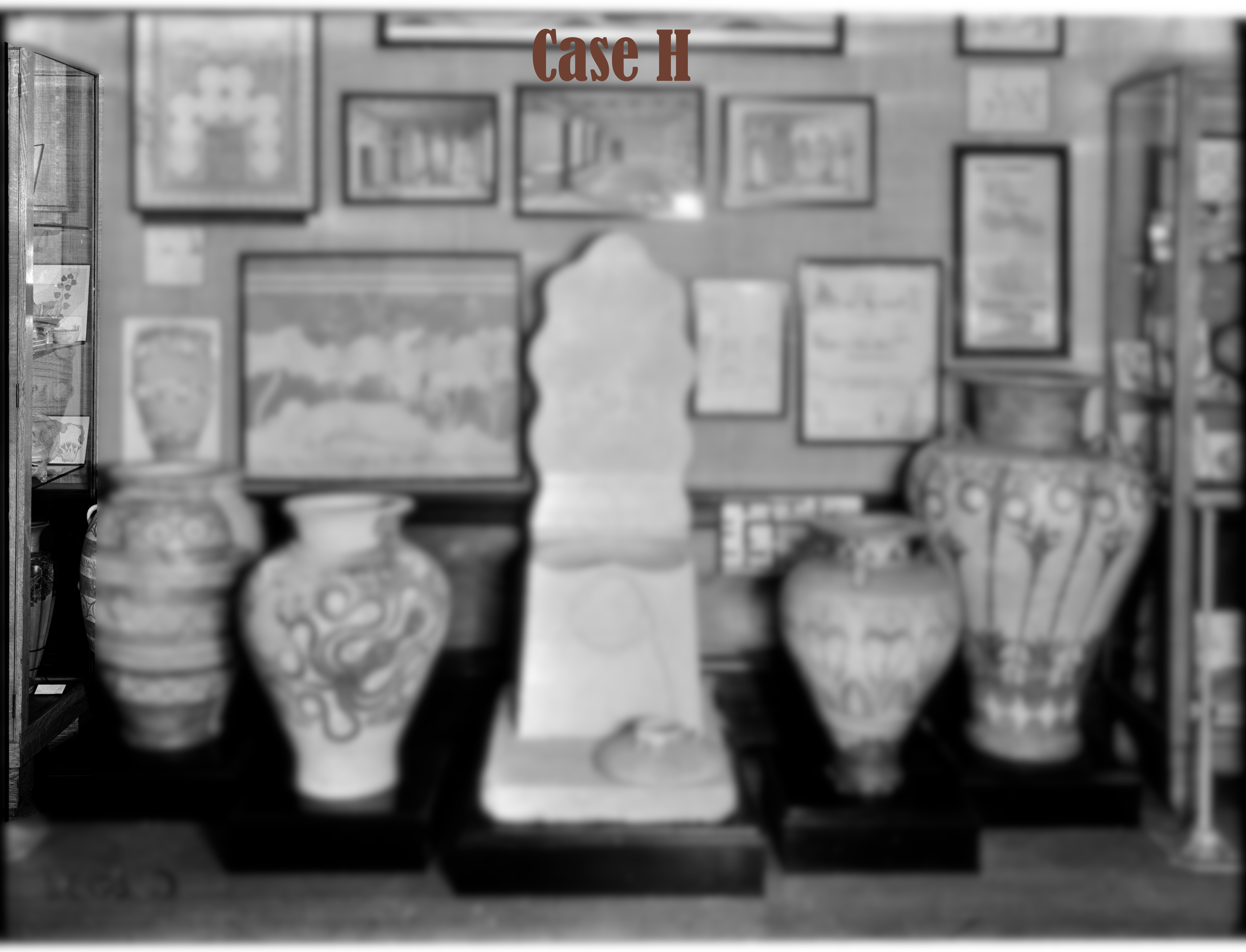
Wall Case H held materials related to the MM III and LM IA periods (c. 1700–1550 B.C). While the case is mostly obscured in the Minoan Room photograph, it is possible to glimpse some objects in the another archive photograph of the wall near the throne. On the second shelf from the top, the (replica) votive vessels from the Temple Repositories are visible. The faience cup with the fern-spray is mentioned in relation to Case F, but is obviously displayed here. There is an exhibition label of a rock and ivy fresco from the House of the Frescoes, but the exhibition label is now missing or perhaps was the original painting. The shelf below also displays a fresco of crocuses and rocks from the House of the Frescoes, although neither of these frescoes are mentioned in the printed catalogue. In front of this label the leg of ‘Ariadne’s Clew-Box’ (the Curious Clay Utensil in the printed catalogue) is visible. On the lower shelf the Fluted Rhyton from the Hall of the Double Axes is clearly visible.
The printed catalogue provides further information about the objects in Case H. Several original and replica vessels of stone were displayed here, including the Handled Vase with plait-work, a limestone bowl with imitation white-spots, the Khyan Lid (possibly with label ‘Stratum of Hyksos Lid Deposit’), a pyxis of limestone from Mycenae, a breccia rhyton, and a fragmented rosette band (see some of these objects below). The middle and lower shelves contained clay vessels such as cups from the Gypsades Well, a lily jar from the Temple Repositories, a tripod ‘egg-stand’, a ‘fire-box’, and a two-handled clay vessel with similarities to Egyptian types (possibly with the label ‘Alabaster Vases’). Examples of fragmentary bowls and cups from the Late Minoan pavement and the Well at Gypsades are illustrated with pieces such as this painted sherd with white detail and this sherd with maroon decoration. Since few of the vessels from the House of the Sacrificed Oxen are in the Ashmolean Collection, it is likely the label ‘Domestic Vessels of MM IIIB Date from House of Sacrificed Oxen’ stood in their place. As this seemed like a large case and most of it is not visible, there is a possibly many more exhibition labels were displayed, including perhaps ‘Vessel in the MM IIIA Style from Early Basements’, ‘MM III Burial Jar from Pseira’, ‘Royal Pottery Stores Knossos’, ‘Royal Pottery Stores with Lily Jar Knossos’, ‘MM III Costumes’, ‘Fountain Fresco from House of the Frescoes’, ‘Fresco Fragment of hand fingering necklace’, and ‘Lilies and Petals Detached by Breeze S.E. House Knossos’. ‘Comparative Table of Funnel-Shaped Rhytons’ was either in Case H or the nearby Case J.
WALL CASE H.-THIRD MIDDLE MINOAN PERIOD (c. 1700–1550 B.C.), WITH TRANSITION TO LATE MINOAN I.
Top Shelf.
HANDLED VASE of veined grey stone, with ringed collar in separate piece, and plait-work decoration: probably it should have two handles.
The plait-work, characteristic of this Period, recurred on a vase fragment in ‘Clytemnestra’s Tomb’ at Mycenae.
LIMESTONE BOWLS, brown and black; and imitation in white-spotted ware. These objects were found in a stratum of the Lustral Area, Knossos, containing the ‘Khyan’ Lid below: see section.
LID OF AN ALABASTRON, INSCRIBED WITH THE NAME OF THE HYKSOS KING KHYAN: facsimile of original found with above vases.
CYLINDRICAL VESSEL (PYXIS) OF GREY LIMESTONE: restored from fragments found in the dromos of the ‘Atreus’ Tomb at Mycenae (see East Room, 120). The grooving and fitting with small holes for pigment (here filled in) fit on to the M.M. IIIa types given above.
‘RHYTON’ OF BRECCIA: illustration, restored from fragments of the side, with incisions for inlay: from dromos of the Atreus Tomb: compare bull’s head ‘rhyton’ of contemporary M.M. III fabric.
These finds, connected with the Atreus Tomb, are decisive as to its early date, which is further corroborated by the discovery of remains of large jars of green Cretan steatite copied from the M.M. III ‘Medallion Pithoi’ of the Palace Magazines, found in the architecturally related ‘Tomb of Clytemnestra’ at Mycenae. See illustration. The lost half-capital of the façade preserved the characteristic M.M. IIIa plait-work decoration.
FRAGMENT OF ROSETTE BAND of reddish brown stone (cast) and restored rosette of M.M. IIIa date (17th century B.C.), found beneath M.M. IIIb 'tarazza’ pavement of the Eastern Column-base of the South Propylaeum at Knossos, at a depth of 70 centimetres. The undercutting of the petals is of unsurpassed fineness: illustrative section by Mr. Theodore Fyfe.
Special attention should be given to these parallels, in view of the fact that these fine architectural features have been brought down to an age of decadence, over three centuries later; with them being included the sculptured plaques from outside the ‘Atreus façade’ (p. 21 above).
FLUTED ‘RHYTON’ of porphyry-like material (restored): from the ‘Hall of the Double Axes.’
POLYCHROME SURVIVALS. Middle Shelves.
‘RHYTON’ OR LIBATION VESSEL, still preserving ostrich-egg form, illustrating M.M. III survival of polychromy: facsimile. It presents three decorative palm-trees and a rope-pattern, maroon and orange, round the mouth.
FRAGMENTARY CUPS AND BOWLS, with somewhat finicking white and maroon decoration: some found in circular rubbish-pits beneath Late Minoan pavement and in Well, at Gypsades. These may belong to M.M. IIIb.
THE ‘JEWEL FRESCO’: coloured drawing: the original has since been mutilated by earthquake.
HOUSE-TABLETS FROM THE TOWN MOSAIC, giving an idea of the Town of Knossos in the 17th century B.C. : (replica and illustrations: one original ‘House-tablet’). The material is a glazed frit, the Minoan ‘faïence’.
VOTIVE VESSELS IN PALE BLUISH GREY FAIENCE, from the Temple Repository: replica; part of the fittings of a shrine of the Snake Goddess (see, too, Case F).
FLYING FISH, ARGONAUTS, AND COCKLES, WITH ROCK BORDER: replicas; from the same deposit: see, too, Case F.
CLAY SEALINGS of this Period, from Zakro in Eastern Crete.
CERAMIC TYPES: MIDDLE MINOAN IIIb. Bottom of Case.
JARS FROM THE TEMPLE REPOSITORIES, with conventional representation of a large flowering plant, illustrating survival of polychromy.
JAR FROM THE ‘MAGAZINE OF THE LILY VASES’, with Madonna lily, white on brown-lilac ground.
VESSELS FROM M.M. IIIb FILLING of the ‘House of Sacrificed Oxen.’
TRIPOD EGG-STAND, to hold six: the glazed black ground perhaps shows metal-work tradition.
CURIOUS CLAY UTENSIL with slot and lateral perforation, of uncertain use: known at the time of discovery as ‘Ariadne’s Clew-box.’
CLAY FIRE-BOX AND HANDLED PAN for embers: from Palaikastro in Eastern Crete.
TWO-HANDLED PEDESTAL-VESSEL, from above the ‘Ivory Deposit’, Knossos, with rings round neck and pedestal: a Minoan derivative from a XIIth Dynasty ‘alabastron’ type, with separate base: an alabaster example was found at Minet-el-Beida in North Syria. Such vessels often show a white wash, and occur already with a red glaze in M.M. IIIa (see Palace of Minos, iv, 778-9).
Area of Throne (including Wall)
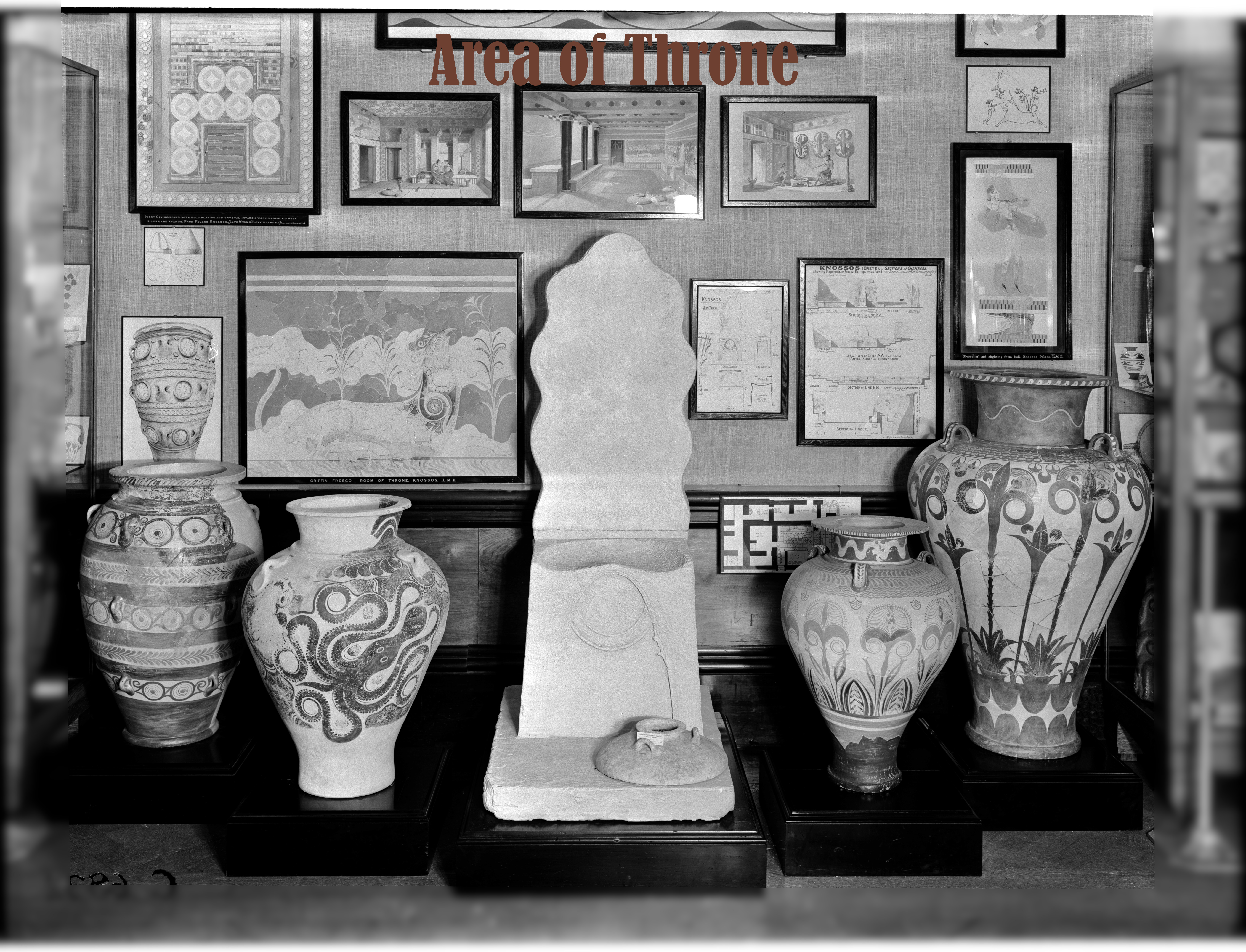
The photograph of the gallery wall with the Throne provides a clear image of the space between Case H and Case J. A replica of the throne from the Throne Room at Knossos was surrounded by a series of ‘Palace Style’ Late Bronze Age jars. The furthest vessel to the left, a pithoid jar from the North-East House and the smaller (replica) jar with papyrus decoration (third from the left) are listed under the descriptions for Case J. The octopus jar and the large jar with conventionalized papyrus (furthest right) were included in the printed catalogue for this section. A flat alabastron sits on the base of the Throne. Directly above the Throne were the coloured restorations of some rooms within the Palace: Queen’s Megaron, Throne Room, and the Hall of the Double Axes. The images provided for these reconstructions may not have been the actual images used in the Exhibition, but they depict the same scenes. Likewise, the diagram of acrobats leaping over a bull was idential to this original drawing but the original label is missing or was reused. Above the coloured restorations was the Shield Fresco in its original exhibition frame. It is possible to see the Female Taureador, Griffin Fresco, and the Camp-Stool Fresco described in the printed catalogue in the image. The Argonaut Fresco was described in the printed catalogue but is not visible in the photograph and perhaps was situated within a Case or on the wall to the left of Case H.
Although not included in the printed catalogue, it is also possible to see a large print of the Royal Gaming Board and an exhibition label depicting Ivory Men for Draught Board. Below these two images was a depiction of a Medallion Pithoi (Evans, Arthur. 1921. The Palace of Minos at Knossos, I. London: Macmillan.) from the Palace of Minos. To the right of the Throne were three plans of the Throne Room area: Ground Plan of the Throne Room and Service Suite (Evans, Arthur. 1935. The Palace of Minos at Knossos, IV. London: Macmillan.), Sections of the Throne (Evans, Arthur. 1935. The Palace of Minos at Knossos, IV. London: Macmillan.), and Sections of Throne Room with original frescoes noted. Finally, above the Female Taureador fresco was a schematic of bull leaping and a small panel which depicted the first bull-leaping figure in the larger Taureador Fresco scene.
It is apparent that the printed catalogue was written before the Minoan Room was finalised as the described positions appear different than the positions of illustrations in the photograph. For example, the Female Taureador Fresco is described as being to the right of Case D when it is actually to the right of Case J.
To right of Case D.
FEMALE TAUREADOR: AN ORIGINAL FRAGMENT OF THIS GROUP OF FRESCOES. Presented to the excavator by the Greek Government. It is in the finest Minoan style, and shows a female taureador wearing the usual male sheath, with her feet above the ground, one arm raised, and the other lowered: a masterpiece of refined work recalling that of the white lekythoi of the 5th century B.C.
Above, such acrobats’ movements, diagrammatically shown.
Right Wall, middle section, between Wall Cases H and L. Centre, above SHIELD FRESCO (reconstruction), from Landing of Grand Staircase.
GYPSUM THRONE, found in position in the Room of the Throne, Knossos. Coloured restoration (above) and detailed decorative features, drawn by Theodore Fyfe. The throne, when found, showed traces of coloured decoration. The arch and crockets curiously suggest Gothic analogies. Latest Palatial Age.
The structural features of the seat show that it was copied from a woodwork original, and it has been therefore translated back into a woodwork model. Placed on floor to left.
THE GRIFFIN FRESCO: reduced coloured copy, taken from that in the left section of the back wall of the Room of the Throne: (L.M. II).
THE FLAT ALABASTRON beside the Throne is one of those which were being filled with oil for a ritual function at the moment of the final catastrophe at Knossos.
LARGE PAINTED AMPHORAS in the ‘Palace Style’ (L.M. I) stand in the enclosed space round the Throne: one shows an octopus; the other a fine decorative motive of conventionalized papyrus, from the Little Palace at Knossos, a special gift of the Greek Government to the excavator.
THE QUEEN’S MEGARON IN THE DOMESTIC QUARTER: interior view as restored.
Above Throne, right.
HALL OF THE DOUBLE AXES; view of a section, with restoration suggested by the Shield Fresco of the staircase (above) of the actual shields of the Minoan 8-shaped form suspended on the walls.
ARGONAUT FRESCO (drawing) from the Middle East-West Corridor of the Domestic Quarter, with background of flowering reeds; identical in style with those associated with the Griffins in the Room of the Throne.
Wall Case J
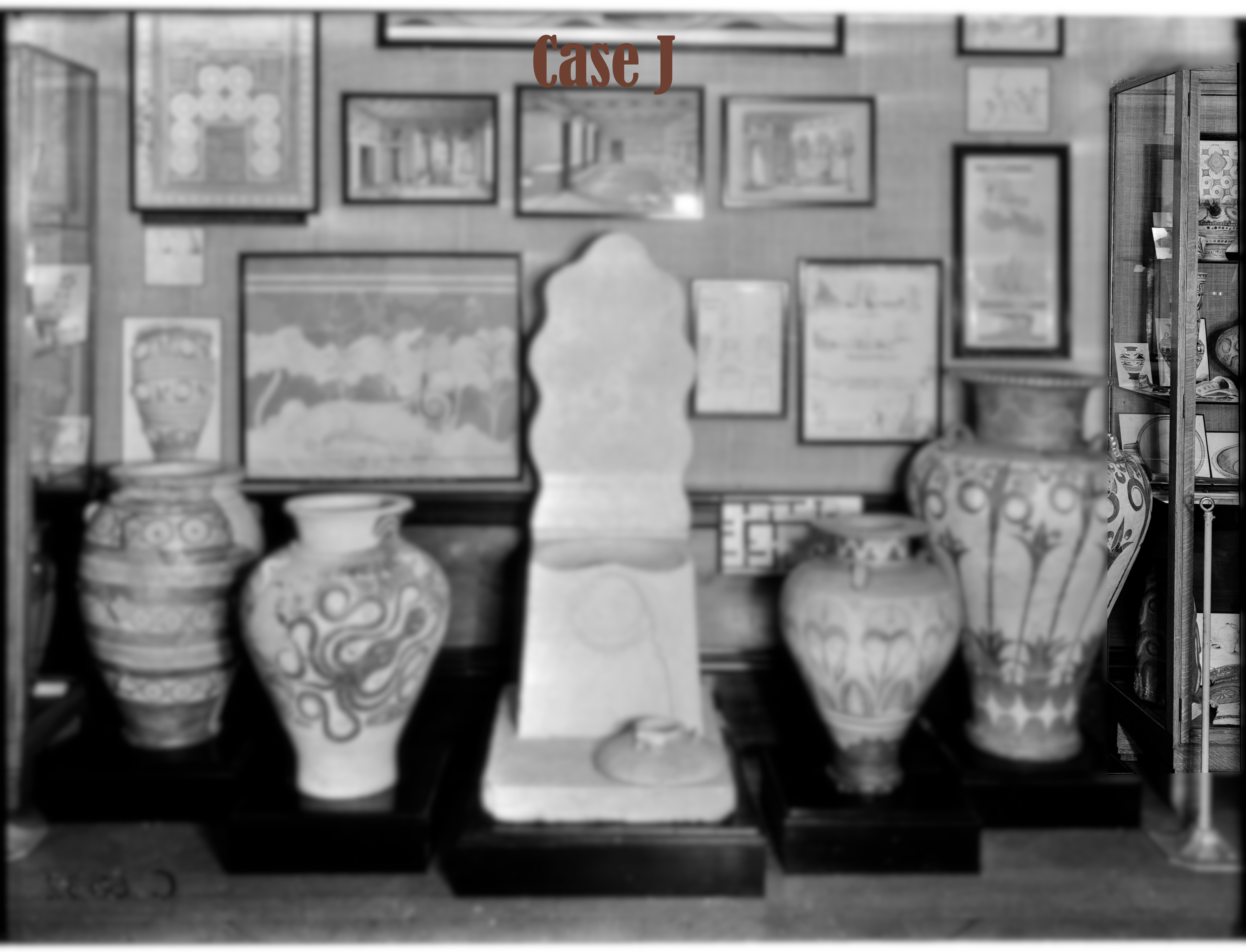
Like Wall Case H, only the edges of Wall Case J can be seen in the photographs. On the upper shelf several ceramics from the printed catalogue are visible, including a bridge-spouted jar with spiral patterns and white dots, a fragment of a cup with ‘tufts of grass’ or reeds, and a sherd with further reed decorations. An upside-down handleless cup with plant designs is also visible in the photograph. Several exhibition labels are present on the upper shelf, one of which was ‘Zakro Vase with Star Anemone’. The neck of a rhyton visible behind the previous exhibition label is likely ‘Zakro Rhyton’. A large, framed image of the Spiral Cornice Fresco stands behind the ceramics. On the shelf below, the following ceramics are clearly recognisable: Stirrup-Handled vase from Gournia, Conical Rhyton with festoons of beads, and a handle sherd with festoons (not included in the printed catalogue). Several other ceramic handles surround the two complete vessels on the second shelf. Behind the ceramics are two exhibition labels which are missing in their exhibition label form but were depicted in the Palace of Minos. One illustrates the amphora from Tylissos which is discussed in the printed catalogue (Evans, Arthur. 1935. The Palace of Minos at Knossos, IV. London: Macmillan.). The other illustrates a Festooned Amphora from Ialysos (Evans, Arthur. 1935. The Palace of Minos at Knossos, IV. London: Macmillan.) which is not mentioned in the printed catalogue unless it might be considered ‘Evidence of the continuance of decadent outgrowth of L.M. Ib, here termed L.M. Ic, on the Mainland side’ which Evans mentions in the printed catalogue (see below).
On the third shelf, there were both illustrations of sword types and original and replica metal objects (Horned Rapier, Sword with Cruciform Hilt, and Short Sword, see below). The illustrations of Sword Types might be some of the following exhibition labels: ‘Later Sword Types, Mycenae’, ‘Cruciform Hilt of Sword’, ‘Early Sword Types from Shaft Graves Mycenae’, ‘Broad Bladed Sword Types Shaft Graves’, ‘Horned Swords from Graves’, and ‘Hilt of Royal Sword from Mallia Palace’. A horned sword type from Mycenae and a bronze spear head from Zafer Papoura are visible on the shelf. According to the catalogue, the ‘Captain of the Blacks’ fresco and replicas of ivory heads, including a boar’s tusk helmet, were near this assemblage. Two illustrations of bronze vessels stood behind the sword display, including ‘Drawing of Bronze Bowl with Foliate Decoration from Palatial Hoard’ which was found separate from the other exhibition labels within the Sir Arthur Evans Archive, illustrating that missing labels may be scattered throughout the archive. The second bronze vessel (Evans, Arthur. 1928. The Palace of Minos at Knossos, II. London: Macmillan.) illustration is from the Palace of Minos.
On the lowest shelf different ceramic vessels illustrated the “Late Palace Style”, including an octopus stirrup-handled vase and two amphoras from Hagia Pelagia. One is linked below and the other may be this stirrup jar with wavy linear decorations. The photographs show two further objects and one exhibition label which were not included in the catalogue: a replica octopus stone weight, a pithos fragment with foliate bands and spirals, and an illustration from the Palace of Minos of the Chieftain’s Grave artefacts (Evans, Arthur. 1935. The Palace of Minos at Knossos, IV. London: Macmillan.). According to the catalogue, to the right of Case J (which is obscured in the photograph) there were a series of illustrations which displayed the pottery from the LM IIIC period. It is possible, through the reflection of the glass in Case F, to see that these labels may have included ‘Architectural Motive Derived from Fresco Designs’ and ‘Late Revival Pottery’.
The following exhibition labels may have also been included within Case J or on the wall to the right of it: ‘Zakro Marine Style Rhyton’, ‘Dagger Blade with Inlaid Cats hunting ducks’, ‘Ewers from Knossos and Mycenae’, ‘Amphora from North West Palace Border’, ‘Jars of the Palace Style’, ‘Temple Tomb Assemblage’, ‘Hoard of Bronze Vessels from Stepped Portico’, ‘Remains of Bronze Rapiers’, ‘Pithoid Amphora from Senmut Tomb in Thebes’, ‘Marseilles Ewer’, ‘Amphora from Royal Villa’, ‘Inlaid Design of Swimmers on Dagger Blade’, ‘Inlaid Design on Mycenae Dagger Blade, Cats Hunting Ducks’, ‘Development of Design on Steatite Rhyton from Knossos, The Ambushed Octopus’, ‘Bronze Dagger with Boar’, ‘Bronze Halberd Blade’, ‘Birds in Late Revival’, and ‘Painted Clay Sarcophagus or Larnax from Anoia’, and ‘Contents of Egyptian Grave of Thothmes III’s time at Sakkara’.
WALL CASE J.-LATE MINOAN I-II (c. 1550–1400 B.C.)
Upper shelf, left.
VASES OF LATE MINOAN Ia STYLE (c. 1550–1500 B.C.) with spiral patterns and white dots 1, 2: unfined white paint is used. Cup with tufts of grass; vetches or wild peas; plant and flower designs.
‘PITHOID’ JAR, with tiers of handles, an outgrowth of the great store-jars (pithoi), in the same style. On the floor to left of Case J.
VASES OF LATE MINOAN Ib STYLE (c. 1500-1450 B.C.). Elongated ovoid ‘rhyton’ with fish, rocks, and sea-tang. Upper Shelf, right.
‘Stirrup-handled’ vase, with octopus and marine details, from Gournia.
Fragments of vases with triton-shells, rocks, sea-weed, etc., chiefly from south-west angle of the Palace.
Conical ‘rhyton,’ with festoons of beads and pendant crocus-flowers, resembling the jewels of the earlier ’ Jewel Fresco. (p. 24).
Amphora, derivative of the ‘pithoid’ class (copy), with similar motives of very beautiful design; from Tylissos, near Knossos.
ILLUSTRATION OF ARMS: LATE MINOAN I-II. Middle Shelves.
SWORD, OF HORNED TYPE, with Gold Pommel (replica), from Mycenae; an outgrowth of earlier Middle Minoan types.
RAPIER, HORNED, from Zafer Papoura cemetery, Knossos; with linked spirals in relief on blade.
FRESCO FRAGMENT: ‘THE CAPTAIN OF THE BLACKS’; copy, partly restored, showing an officer, with two spears, at the head of a column of negro mercenaries. It looks as if the last rulers of Knossos had made use of black troops to maintain their dominion. As this seems to have extended to the Argolid, it looks as if Ibrahim Pasha’s employment of black troops in the Morea may have been anticipated by over thirty-two centuries.
SWORD WITH CRUCIFORM HILT, microscopically executed in the latest Palace Style; (from Zafer Papoura tomb) and illustration of a gold-mounted sword-hilt from the ‘Chieftain’s Tomb,’ Knossos. Label
SHORT SWORD, with inlaid ivory hilt plates; replica, from Mycenae.
IVORY-HEADS, replicas, from Mycenae; to illustrate Late Palatial form of helmet, decorated with boar’s tusks.
TYPICAL BRONZE SPEAR-HEADS; of the same date; from Zafer Papoura tomb.
POTTERY ILLUSTRATING THE LATE ‘PALACE STYLE.’ Bottom of Case.
On the adjoining floor space near the Throne are large jars in this style, among them a fine example adorned with papyrus; Stirrup-handled vase with octopus design; in the field between its tentacles the ‘triple-C’ pattern. This pattern is derived at Knossos by gradual stages from a triple group of marine growth characteristic of the finest L.M. Ib style: see Table annexed.
TWO AMPHORAS OF EARLY L.M. IIIa style, from Hagia Pelagia, West of Knossos, illustrating the survival of the latest Palatial style after the final destruction of the Palace.
For reasons of space, no attempt has been made here to exhibit Minoan pottery of a later date than the end of the Palace period (с. 1400 B.C.). Illustrative drawings, however, are exhibited on the Wall-section to right of Case J. These give samples of different lines of development: they include:—
(1) The Cretan Late Minoan IIIa, showing the survival of the L.M. I Palatial decoration.
(2) The Mainland and Aegean survival of Late Minoan IIb, at a time when the ’ Palace Style’ of L.M. II was in vogue at Knossos, and in parts of the Argolid.
(3) Evidence of the continuance of decadent outgrowth of L.M. Ib, here termed L.M. Ic, on the Mainland side.
(4) The rapid transformation under a strong impulse from the Cretan side of L.M. IIIa into a different Late Minoan style, a stage already reached at Tell-el-Amarna in Akhenaten’s time (c. 1360 B.C.). Purely Knossian decorative motives, such as the ’ three C’s’ derived from the marine L.M. Ib style, are traceable. See illustration. Label
Collateral proof of this strong Knossian reaction on the Mainland side in the epoch about or immediately succeeding the final destruction of the Palace, is afforded by the discovery of a series of vases at Thebes and Orchomenos at Eleusis, Tiryns, and Mycenae, bearing ‘Linear B’ inscriptions, of the last Palatial style. At Mycenae itself, wall-decoration is found reproducing the striated sprays of the late Palatial decoration at Knossos.
Desk Case L
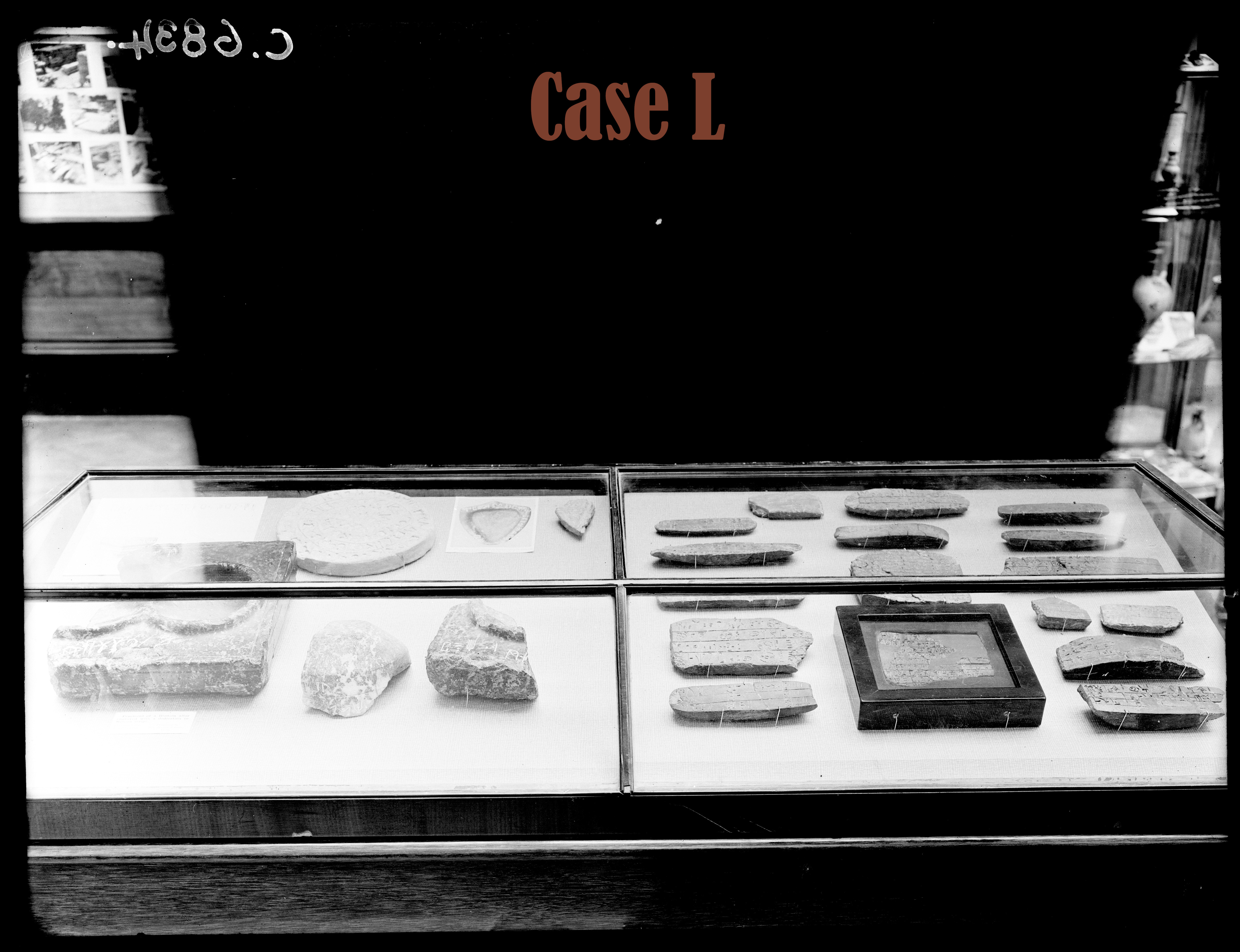
It is fortunate that a photograph of Desk Case L is preserved within the BSA Archives. Based on the background objects in the photograph, Case L was located near Case C (note the excavation photos and the necklaces from the Abdyos deposit in the background). However, Case L is not visible in the larger view of the Minoan Room and perhaps it was moved before or after the Minoan Room photo was taken (perhaps in the middle of the room where some un-swept debris remains) or it was situated in front of Case A out of the photograph frame.
In the photograph it is possible to see the two pieces of the Diktaean (or Psychro) Cave libation table with Linear A inscription, as well as a comparable example of a Stone Vessel with Linear A inscription. An exhibition label of the Trullos ladle with Linear A (see ‘Ladle Shaped Vessel with Linear A from Trullos’) seemed to sit next to a fragment of a stone ladle, possibly this one from Mount Juktas. A replica of the Phaistos Disk was above the stone Linear A examples. To the left of the Phaistos Disk was an exhibition label illustrating a Linear A inscription on a libation table from the House of the Frescoes (Evans, Arthur. 1928. The Palace of Minos at Knossos, II. London: Macmillan.). A faint image of the exhibition label is discernible if one zooms to the top corner of the Diktaean libation table.
The photo shows a series of seventeen Linear B tablets although these are not further described in the printed catalogue. They are all identifiable, and several are replicas made by the Ashmolean conservator W.H. Young. Even so, the printed catalogue describes them all as ‘original’. No exhibition labels related to Linear B scripts are present in the photograph but the printed catalogue reported several above the case. Again, this calls into question the position of Case L. It is possible that these exhibition labels hung on a wall out of the photograph frame (perhaps by Case A) or they were intended for Case L, but did not actually make it into the display. These include ‘Human Figures in Linear B’, ‘Comparative Inscriptions from Stirrup Jars and Cypro-Minoan Signs’, ‘Linear B Tables’, ‘Inscriptions on Theban ‘Stirrup Vases’’, ‘Votive Clay Ram with Linear B’, and ‘Linear B Document without Numerical Indications’.
DESK CASE L.-SPECIMENS OF LINEAR SCRIPT.
ORIGINAL INSCRIBED FRAGMENT OF LIBATION TABLE from the Diktaean Sanctuary-Cave, with Linear Script A.; with other parallels 1, 2.
REPLICA OF THE PHAESTOS DISK; a non-Cretan hieroglyphic inscription, probably from South-West Asia Minor. Centre and right.
SERIES OF ORIGINAL CLAY TABLETS FROM KNOSSOS, presented to the excavator by the Cretan Government, before the Union with Greece. [1], [2], [3], [4], [5], [6], [7]; [8], [9], [10], [11], [12], [13], [14], [15], [16], [17].
SPECIMENS OF ADVANCED MINOAN LINEAR SIGNARIES as adapted to printer’s type by the Oxford University Press.
SIGNARIES OF THE VARIOUS CLASSES OF SCRIPT. Above the case.
TABLES SHOWING THE NEWLY-DISCOVERED MAINLAND SIGNS OF THE LINEAR CLASS, and their comparisons with the late Palatial script of Knossos.
SERIES OF MAINLAND SIGN GROUPS, as seen on the vases from Thebes in Boetia, Eleusis, and Tiryns, and containing identical groups.
It thus appears that in the 14th century B.C. the language of the intrusive population from Minoan Crete was still spoken in the chief civic centres on the Mainland.
Other Exhibition Labels
Approximently fifty exhibition labels found in the Sir Arthur Evans Archive defy categorization by case because of their subject matter, or may have not been included in the Minoan Room, despite being found with the other labels. It is possible that some of the labels are not visible in the photographs or did not clearly relate to objects in the printed catalogue. Additionally, they could have been used in other exhibitions, such as the permanent display of Minoan material in the Ashmolean Museum. It is equally possible they were framed and prepared for the 1936 Minoan Room, but were never displayed because of changes in exhibition display.
It is possible some of these framed labels were included on the wall displays, but are not visible in the photograph: ‘Cult Scenes on Agia Triadha Sarcophagus’, ‘Spring Chamber and Niche by Caravanserai’, ‘Plan of South Hall of South Propylaeum’, and ‘Elevation of West Bastions of North Entrance Passage’.
The following labels were possibly included in the Exhibition but their Case is unknown, or they were potentially not included in the Exhibition: ‘Sacral Knots and Plume at Knossos and Mycenae’, ‘Minoan Houses’, ‘Sacred Pillar’, ‘Flying Fish and Lily Fresco Fragments’, ‘Plan and Section of Shrine of Double Axes’, ‘Arrangement of Draught Board’, ‘Socket Gypsum Jamb and Locking Pin’, ‘Gold Ornament from Tomb III’, ‘Bronze Fibula’, ‘Tiryns Bronze Statuette’, ‘Glass Handle’,‘Lock System in South House’, ‘Cave of Eileithyia at Amnisos’, ‘Gold Plate Figures from Mycenae’, ‘Comparative Table of Date Palm Type on Minoan Vases’, ‘Terracotta Relief from House of Sacrificed Oxen’, ‘Model of Ox Wagon in Painted Clay’, ‘Cupped Slab from Mallia’, ‘Clay Palanquin Photograph’, ‘Gold Shrine Ornament from Shaft Graves’, ‘Minoan Ships’, ‘Remains of Crouched Skeleton in Larnax from Tomb 80’, ‘Fetishes or Natural Concretions from Little Palace’, ‘Butterflies and Chrysalises’, ‘Comparative Table of Proto-Geometrical Types from the Spring Chamber and Tombs at Karakovilia’,‘Royal Tomb of Isopata and Comparative Examples’, ‘Gold Jewellery From Shaft Grave’, ‘Clay Palanquin from Knossos’, ‘Hut Urns’, ‘Lion-Headed Natural Concretion’, ‘Profiles of Rims of Pithoi’, ‘Shell Cameo’, ‘Representations of Horses’, ‘Shrine of the Double Axes’, and ‘Plan of Roman Pavement discovered near Broad Street London’.
Within the framed exhibition label collection, there are chronological maps of Crete that were originally published in John Pendlebury’s The Archaeology of Crete, but as this volume was published in 1939 it is very likely they were not included in the 1936 Exhibition and instead belonged to the Ashmolean Museums’s permanent Minoan Room ‘Neolithic Sites Map’, ‘Subneolithic and Early Minoan I Sites Map’, ‘Early Minoan II Sites Map’, ‘Early Minoan III Sites Map’, ‘Middle Minoan I Sites Map’, ‘Middle Minoan II Sites Map’, ‘Middle Minoan III Sites Map’, ‘Late Minoan I Sites Map’, ‘Late Minoan II Sites Map’, and ‘Late Minoan III Sites Map’.
The following images were found among the collections of original drawings (separate from the other materials presented), but there is some evidence to suggest they may have been displayed or at least considered for the Minoan Room. ‘Comparative Knossos and Delphic Omphalos’ was certainly an exhibition label because it has faint traces of black tape framing around the edges and the handwriting on the panel is similar to others in the Exhibition (see ‘Fragement of Bowl from Ras Shamra’ and ‘Jars of the Palace Style’). In a similar way, ‘Drawing of Donkey as Pack Animal from Phaistos’ resembled ‘Model of Ox Wagon in Painted Clay’ with its handwritten caption attatched at the bottom of the drawing. ‘Drawing of Stone Ladle’ has torn glue spots on its reverse that suggest it was pulled away from a display board or frame.
Some original drawings had the phrase ‘cut pp. rings’ on the reverse or side of the images. The use of the phrase ‘rings’ may refer to the small metal rings for wall hanging on the reverse of the framed exhibition labels. While ‘cut pp. rings’ may mean something else entirely, the labels are included here nonetheless in order to demonstrate how other archival materials may relate to the exhibiton: ‘Drawing of Larnax from Tomb 87 of Zafer Papoura Cemetery’, ‘Drawing of EM III Anthropomorphic Vase from Mochlos’, ‘Drawing of Bronze Cup of Vapheio type from Mochlos’(this one a duplicate of ‘Bronze Cup of Vapheio Type from Mochlos’), ‘Drawing of Comparative Hairstyles of Libya, Crete and Egypt’, ‘Drawing of Alabaster vessel of Syro-Egyptian type from Harbour Town, Knossos’, ‘Drawing of MM IIB Jug from Phaistos with flower decoration’, ‘Drawing of MM IIB Jar from Phaistos with four-arm spiral’, ‘Drawing of Vase with beetles in relief from Royal Pottery Stores’, ‘Drawing of Pithoid Jar from the North East House’, and ‘Drawing of LM I Jar with double axe from Gournia’.
Notes
1 Probably AN1895.861. Illustrated in Evans, Arthur. 1928. The Palace of Minos at Knossos, II. London: Macmillan..
2 The other one is likely to be AN1938.1098 but it was not published by Evans and so the acquisition date is unknown.
3 This refers to a sealing in the Ashmolean collection, although the printed catalogue only refers to a drawing
4 The “Smyrna Ring” is illustrated by Evans (Evans, Arthur. 1925. ‘The Ring of Nestor’. A Glimpse into the Minoan After-World, and a Sepulchral Treasure of Gold Signet-Rings and Bead-Seals from Thisbê, Boeotia. London: Macmillan.; Evans, Arthur. 1930. The Palace of Minos at Knossos, III. London: Macmillan.) but is now lost. It is regarded as a forgery (Krzyszkowska, Olga. 2005. Aegean Seals: An Introduction. London: Institute of Classical Studies.).
5 See Butcher, Kevin and Gill, David. 1993. ‘The Director, the Dealer, the Goddess, and Her Champions: The Acquisition of the Fitzwilliam Goddess’, American Journal of Archaeology 97(3), pp. 383-401..
6 The Ashmolean was given a replica of the Boy-God by Evans.
Bibliography
- Butcher and Gill 1993
- Butcher, Kevin and Gill, David. 1993. ‘The Director, the Dealer, the Goddess, and Her Champions: The Acquisition of the Fitzwilliam Goddess’, American Journal of Archaeology 97(3), pp. 383-401.
- Evans 1921
- Evans, Arthur. 1921. The Palace of Minos at Knossos, I. London: Macmillan.
- Evans 1925
- Evans, Arthur. 1925. ‘The Ring of Nestor’. A Glimpse into the Minoan After-World, and a Sepulchral Treasure of Gold Signet-Rings and Bead-Seals from Thisbê, Boeotia. London: Macmillan.
- Evans 1928
- Evans, Arthur. 1928. The Palace of Minos at Knossos, II. London: Macmillan.
- Evans 1930
- Evans, Arthur. 1930. The Palace of Minos at Knossos, III. London: Macmillan.
- Evans 1935
- Evans, Arthur. 1935. The Palace of Minos at Knossos, IV. London: Macmillan.
- Krzyszkowska 2005
- Krzyszkowska, Olga. 2005. Aegean Seals: An Introduction. London: Institute of Classical Studies.